There is something I came across while reading about the history of Odia periodicals that made me stop reading for a moment. Today, Odia writers pour their time, imagination, and knowledge into magazines, journals, and literary publications, often without receiving any payment. The unspoken assumption is that being published is itself a reward. And then I discovered something that surprised me.In 1891, more than 135 years ago, an Odia literary journal was actually paying writers for their creative work.
The journal was Utkal Prabha (ଉତ୍କଳ ପ୍ରଭା). Published in April 1891 from the royal press of the Maharaja of Mayurbhanj, under the editorship of Chaitanya Prasad Ray, Utkal Prabha soon became an important voice of the contemporary literary circle. Rajnarayan Mahapatra also served as its editor for a period.
But what fascinated me most was not simply that the journal paid writers. It was the reaction of the writers themselves.
Fakir Mohan Senapati refers to Utkal Prabha in his Nananka Panji, capturing the excitement of poets who suddenly felt that their writing might actually have material value:
“Seeing Prabha rise, the poets thought all our troubles would end;
We would write poetry, receive money, and everyone would read.”
(“ପ୍ରଭା ଉଦେ ଦେଖି କବିଏ ଭାବିଲେ ଯିବ ଆମ ସବୁ ଦୁଃଖ
ଲେଖିବୁ କବିତା ନେବୁ ଟଙ୍କା ଗଣି ପଢ଼ିବେ ସକଳ ଲୋକ ।”)
There is something wonderfully human in those lines; the excitement, the relief, the hope that perhaps, at last, someone had begun to value the labour of writing.
Utkal Prabha became a space where some important works of nineteenth-century Odia literature appeared: Ramashankar Ray’s Bibasini; Radhanath Ray’s Chilika, Mahajatra, and Jajatikeshari; Madhusudan Rao’s Rushi Prane Debavatarana; Biswanath Kar’s Sahitya Charcha; and Gangadhar Meher’s Indumati.
They became part of the foundation of modern Odia literature. And that made me curious. To understand that moment, I had to go back much further; to a time when there were hardly any printed Odia periodicals at all.
1840-1850
The story begins around 1840 with a remarkable publication called Kujibara Patra (କୁଜିବର ପତ୍ର). It was published by Sadhusundar Das, also known as Sundar Babaji, the ascetic associated with Kujibara Math near Choudwar. Born in 1775, he belonged to a generation that lived before the arrival of a developed printing culture in Odisha. Sutton had encountered Sadhusundar Das as early as 1826.
Kujibara Patra was handwritten. That detail alone is extraordinary.
Then came Reverend C. Lacey’s Jnanaruna (ଜ୍ଞାନାରୁଣ) in 1849, regarded as the second periodical in Odia. It too was short-lived, disappearing almost immediately after its first publication. Both Kujibara Patra and Jnanaruna are now lost. The publications that helped begin the story have vanished, leaving behind only references to their existence. But the attempts continued.
1850-1860
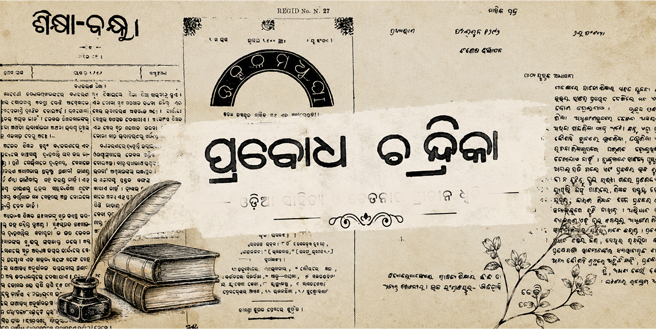
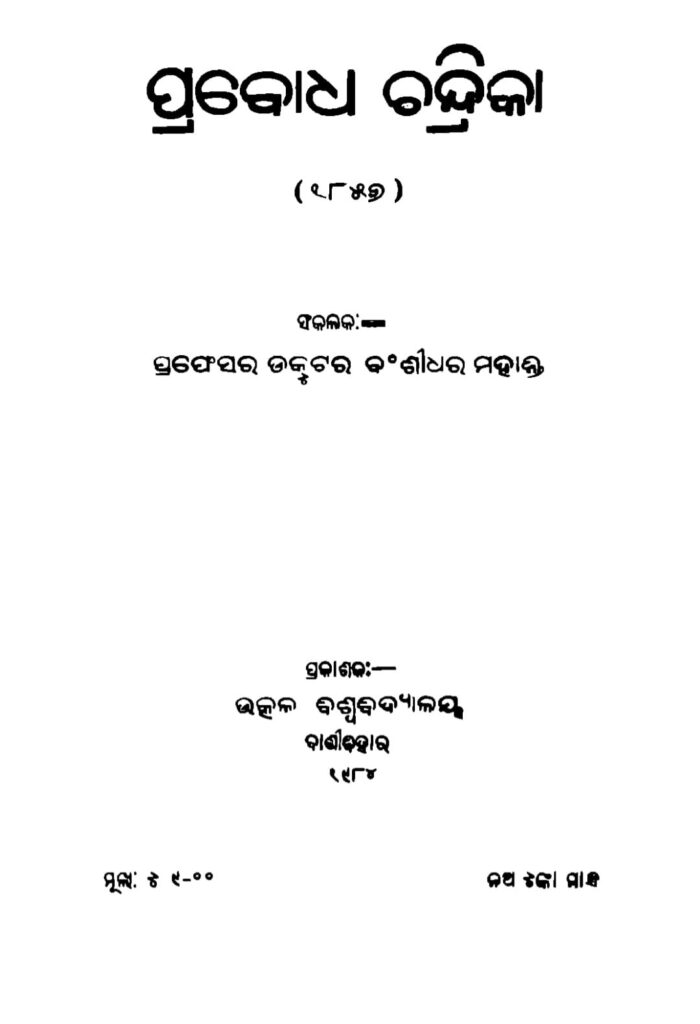
William Lacey, who had attempted Jnanaruna, returned with a monthly literary journal, Prabodha Chandrika, (ପ୍ରବୋଧ ଚନ୍ଦ୍ରିକା) published from the Cuttack Mission Press in 1856.
It is generally regarded as an important landmark in the emergence of printed Odia periodical literature associated with the period 1855–57. What is particularly interesting about Prabodha Chandrika is that although it was produced by a Christian missionary press, it was not a Christian religious journal in its literary content. Instead, it functioned largely as a modern literary publication. For two years, in 1856 and 1857, it appeared month after month.
Two years may seem brief. But the early history of Odia periodicals was made up of such brief lives. One publication would appear, survive for a few years or sometimes only months and disappear. Then another would emerge, carrying the tradition forward.
In 1861 came Arunodaya, (ଅରୁଣୋଦୟ) a monthly published by the Christian Vernacular Society. It continued for three years before being discontinued.
Each of these publications was small and fragile. Together, however, they were building something much larger: an Odia reading public.
1860-1870
Then, in 1866, something happened that changed the scale of Odia journalism and literature. On 4 August 1866, Utkal Dipika (ଉତ୍କଳ ଦୀପିକା) appeared. Edited by Karmayogi Gaurishankar Ray (1839–1917), it became one of the most important publications in the history of nineteenth-century Odisha. It was published from the Cuttack Printing Company at Alamchand Bazar, Cuttack.
There was, however, a practical problem. Odia printing infrastructure was still developing, and there was an inadequate supply of suitable Odia type. So during its early period, Utkal Dipika was printed using lithographic stone printing. The newspaper began as a weekly and later became a daily. And unlike many of its predecessors, it endured. For nearly sixty-six years, Utkal Dipika remained an important voice of Odisha, expressing the hopes, aspirations, concerns, and ambitions of the Odia people. It helped strengthen the position of the Odia language and gave journalism a powerful role in the cultural life of the region.
Sixty-six years. When so many early periodicals had disappeared after only a few years, that endurance was extraordinary. And Utkal Dipika was not alone for long.
In 1868 came Utkal Hitaishini (ଉତ୍କଳ ହିତୈଷିଣୀ) and Baleshwar Sambad Bahika (ବାଲେଶ୍ୱର ସମ୍ବାଦ ବାହିକା) extending the reach of periodical literature beyond Cuttack and helping create a wider literary and cultural network. The Odia periodical was no longer an isolated experiment. It was becoming a movement.
1870-1880
By the 1870s, Balasore had emerged as another important centre of Odia literary activity. In 1873, Utkal Darpan (ଉତ୍କଳ ଦର୍ପଣ) appeared from the Utkal Press of Balasore under the patronage of Raja Baikunthanath De. Among its contributors were two names that would become central to the story of modern Odia literature: Radhanath Ray and Bhaktakabi Madhusudan Rao. Radhanath Ray’s essay Bibeki was published in Utkal Darpan. Around the same time, another periodical, Utkal Putra (ଉତ୍କଳ ପୁତ୍ର), appeared as a fortnightly publication. What particularly caught my attention was its concern with women’s education.
In 1873. At a time when the expansion of education itself was still a major social question, an Odia periodical was already making women’s education part of its literary and social conversation. The periodical press was beginning to do more than publish literature.
It was beginning to participate in society.
1880-1890
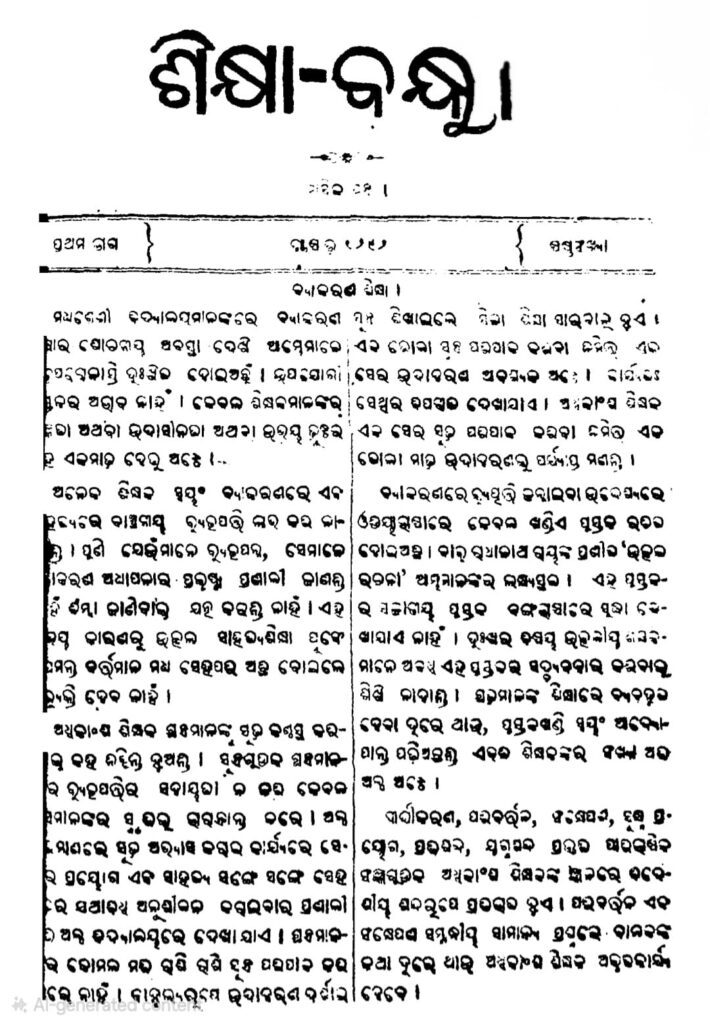
By 1885, the number of literary publications was growing. Two significant journals, Pradip (ପ୍ରଦୀପ) and Shikshabandhu (ଶିକ୍ଷାବନ୍ଧୁ) appeared that year. Neither survived for very long, but both contributed to the development of Odia literary culture. Writers such as Sadhucharan Ray, Madhusudan Rao, Baikunthanath Dutta, and Prabhakar Sharma were regular contributors. Shikshabandhu was particularly interesting because it published literary criticism of Madhusudan Rao’s poems Akasha Prati and Jibana Chinta. This was an important development. Odia literature was beginning not only to produce literature but also to discuss, question, and evaluate itself. A literary culture was taking shape.
Then, in 1887, Naba Sambad (ନବ ସମ୍ବାଦ) appeared, along with a periodical simply titled Odia (ଓଡ଼ିଆ), which was published from Balasore. Odia drew public attention to problems faced by pilgrims visiting Lord Shri Jagannath at Puri, showing how the periodical press could become an instrument of social concern. Later the two publications eventually merged to form Odia Naba Sambad, (ଓଡ଼ିଆ ନବ ସମ୍ବାଦ) with contributions from writers such as Madhusudan Rao, Radhanath Ray, Kampal Mishra and others. And the movement was spreading further.
In 1889, Sambalpur Hitaisini (ସମ୍ବଲପୁର ହିତୈଷିଣୀ) appeared from Sambalpur and created what historians describe as a significant stir in Odisha. Nilamani Vidyaratna was among its editors.
This is one of the things I find most fascinating about the history of nineteenth-century Odia periodicals. The story was not confined to one city. It was happening in Cuttack, Balasore, Sambalpur, Ganjam, Mayurbhanj and elsewhere. Different centres were developing their own voices, their own publications, their own literary circles. The periodical press was becoming a network connecting the social and intellectual life of Odisha.
1890-1900
And then we arrive at Utkal Prabha. In April 1891, came a journal that introduced something particularly remarkable into this growing literary world: remuneration for writers’ creative work. And the line by Fakir Mohan in Nananka Panji makes me smile every time I think about it.
Imagine the excitement of those writers. A new journal had appeared. Perhaps they could write. Perhaps they could be published. And perhaps, finally, they could be paid. That small payment represented something much larger than money. It represented recognition.
By then, the world of Odia periodicals had come a very long way from the handwritten Kujibara Patra of around 1840.The journey had taken about fifty years. But what had changed in those fifty years was enormous. There was now an expanding reading public, a growing community of writers, competing literary journals, literary criticism, social commentary, journalism, regional publishing centres and, at least in one important instance, an acknowledgement that writers deserved payment for their work.
The literary world of Odisha did not become quieter after Utkal Prabha. On 17 August 1893, Indradhanu appeared from Cuttack. A month later, on 16 September, Bakula appeared from Deogarh in Bamanda. For roughly a year, it stopped for some internal disputes and disagreement.
This too tells us something important. A healthy literary culture does not simply produce writers. It produces disagreement. It creates spaces where ideas can confront one another, where one generation can question another, and where literature can argue about what it should become.
Then, in 1897, came another landmark: Utkal Sahitya, (ଉତ୍କଳ ସାହିତ୍ୟ) under the editorship of Biswanath Kar. Unlike so many of the journals that had appeared and disappeared during the previous decades, Utkal Sahitya continued for more than half a century. Its pages became a gathering place for generations of Odia writers. In its early years, it published writers such as Fakir Mohan Senapati, Radhanath Ray, Madhusudan Rao, and Gangadhar Meher. Later generations followed, including Kalindicharan, Baikunthanath, and Sachidananda. By then, the Odia periodical had become something far more significant than a vehicle for printing articles and poems. It had become an archive. An archive of changing literary tastes. An archive of arguments. An archive of social concerns. And, above all, an archive of the making of modern Odia identity.
When I look back at this journey; from the handwritten pages of Kujibara Patra around 1840 to the long life of Utkal Sahitya at the end of the century, I no longer see a simple list of old magazines and newspapers. I see a language building a public life for itself. Odia was facing enormous challenges in the nineteenth century. It had to fight for recognition, for its place in education and administration, and for the legitimacy of its own literary existence. And while that struggle was taking place, these periodicals were creating something essential. They gave writers somewhere to write. They gave readers something to read. They gave critics somewhere to argue. They gave society a place to discuss itself. And they connected literary voices across Odisha; from Cuttack and Balasore to Sambalpur, Ganjam and Mayurbhanj.
Some survived for decades. Some disappeared after a few issues. Some were printed on presses. One was handwritten. Some were missionary publications. Others emerged from royal presses or local printing houses. But together they created the foundation on which modern Odia literary culture could grow. And somewhere in that journey, in 1891, Utkal Prabha did something that still feels remarkable to me. It paid writers. Perhaps the amount was small. But the message was not.
More than a century later, that message still deserves to be remembered. Because the history of Odia periodicals is ultimately not only the history of publications. It is the history of a language finding its readers, its writers, its arguments, its identity and gradually finding a public voice of its own. And perhaps that is why the little line from Fakir Mohan stays with me:
“We would write poetry, receive money, and everyone would read.”
It sounds almost like a simple wish. But behind that wish was the beginning of something much larger; the dream of a literary culture in which Odia writing could not only exist, but be valued.