
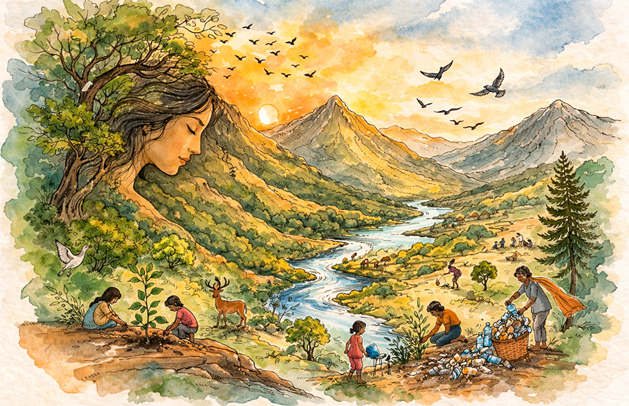
Whenever I look around this small house, embraced on three sides by a modest garden, it often feels like a fragment of paradise. The flowers, the quiet, and the gentle presence of nature soften something within me. In those moments, the pain and anxiety I carry about the state of the world slowly transform into hope — hope for peace, hope for love, hope for non-violence, hope for harmony, and hope for equality and freedom of expression.
Yet beyond this fragile serenity, the world appears weighed down by the burdens we have created for ourselves. The debris of our greed, fear, and violence travels with us, shaping our times. Ours is an age witnessing wars — wars that often feel as though they are thrust upon ordinary people without their consent. A conflict between two nations rarely remains confined to their borders; its consequences ripple across the entire world. The tensions between Iran, Israel, and the United States, for instance, cannot be understood as affecting only those regions. Their impact is global.
Much has been said about the economic consequences of wars, and analyses continue with great intensity. But far less attention is paid to another, deeper devastation — the toxic smoke released from the modern explosives that scar the earth and sky. The scale of environmental and atmospheric damage caused by these weapons has barely begun to be assessed. Whether it is the pollution unleashed by warfare, or the destruction of forests and ecosystems in the name of political and corporate gain, humanity today stands amid a far larger and quieter war — a war against nature itself, and ultimately against humanity.
In India, too, such environmental battles are unfolding at multiple levels. One of the most significant among them concerns the ancient Aravalli hills, which today stand under growing threat. What exactly are the Aravalli hills? Are they merely a chain of mountains on the map, or do they hold deeper ecological and civilizational meaning? This short article attempts to explore these questions in the light of the recent decision of the Supreme Court of India.
I have walked the Aravalli Hills. I have run along their paths, laughed, played, stumbled, and danced upon their uneven ground. I have shared the quiet radiance of the Amaltas (golden shower), and played a festival of colours with Bougainvillea—white, pink, orange, yellow, and deep magenta—strewn across the earth like offerings. I have known Kachnar and countless so-called “wild” flowers as companions rather than curiosities. I have watched young nilgai calves disappear playfully into dense thickets, and heard rain-soaked peacocks calling from hostel balconies of Jawaharlal Nehru University (New Delhi, India). Among these hills and forests lie the roads of Jawaharlal Nehru University, where I travelled alone and unafraid, in the company of ideas. Gandhi, Marx, Walter Benjamin, Erich Fromm, Isadora Duncan, Vincent Van Gogh, and Bhagwati Charan Verma, Kabeer, Tulsidas, Andal, Akka Mahadevi along with them many walked beside me—silent yet present—as I moved through these roads late into the night. The Aravallis have borne witness to innumerable stories: of love and separation, of rebellion and dreaming, of hope that persists even in the face of despair.
My first encounter with the Aravallis, however, was not physical but imagined. I discovered them in a school geography textbook. The name itself—Aravalli—held a strange allure. As a child, I wondered whether I would ever see these hills. Reading the textbook’s sparse facts, my imagination filled in what knowledge could not provide. What might the Aravalli Hills look like? Among all mountains, it was the Himalayas and the Aravallis that occupied my thoughts most. Even the phrase “small hills” felt thrilling. If hills were small, how immense must mountains be? And what of the very great ones—did they touch the sky, as the Himalayas seemed to do? How extraordinary it must be to see the Himalayas, to see the Aravallis.
At that time, I did not know that both would become so intimately familiar. In childhood, everything felt close in imagination, even if it was geographically distant. These perceived distances expanded the canvas of our inner worlds, allowing us to create landscapes of our own. We created mountains of our own. In drawing classes, hills appeared in a distinctive, almost ritualised form. We watched with rapt attention as our teacher sketched mountains, open skies, birds in flight, winding rivers, and trees. Though we could never reproduce those scenes with the same precision, the act of observing their emergence, filling them with colour, and imagining ourselves moving through them brought profound joy. In that imagined space—where the visible merged seamlessly with the invisible—deodar and chir trees transported us into a realm of wonder. Each time a river flowed out of the lap of the mountains on paper, it evoked a sense of awe.
A similar wonder returned years later when I encountered the lush greenery and quiet beauty of the Aravalli landscape upon entering the university campus—though it represents only a small fragment of the vast Aravalli range. For a child like me, born at the cusp of the 1970s and 1980s, it was inconceivable that mountains and hills could be entirely erased by human intervention, or that rivers could be mechanically narrowed, diverted, or reshaped. Even today, despite having witnessed such transformations repeatedly, this reality remains difficult to reconcile within my imagination.
Hills are, after all, the lap of nature. In their vastness and antiquity, they hold within them the memory of humanity itself. They are as steep as they are deep, spreading across rises and descents like a mother’s protective veil. Beneath this veil lies abundance; within it, shelter and sustenance. And yet, there is something deeply unsettling about the modern human condition. We seek our identity not from the source that sustains us, but from caste, religion, sect, and other narrow markers. Entire systems of life, even the earth itself, seem to follow a few such frenzied constructs, distancing themselves from their true essence.
We are all part of nature. Nature is our mother—this is not metaphor alone but a truth echoed in our everyday life and also in the Vedas and the Puranas. When someone gently asks my name, the entire universe rushes before me. There is no singular, isolated “I” within me. My identity is woven into everything that exists. And so, when my identity is confined—defined only as daughter or sister, party member or organisational affiliate, follower of one religion, one caste, one nation—it feels like being bound in chains, as though my breath itself is being guarded. Rivers, mountains, birds, sky, children across the world, stars, oceans, dense forests, every grain of sand, every tear gathered at the corner of the eye, the quiet sweetness of a smile, the love and blessings of mothers everywhere—all of these constitute who I am. I cannot separate myself from even one of them. Just as children killed in wars are part of my identity, so too are the Aravalli Hills.
To save the Aravallis, then, is not merely an environmental or physical struggle. It is a struggle for existence, for identity itself. And it is not the struggle of an individual alone. Within this “I” reside history, the present moment, and the future. You and I—indeed, all of us—are contained within it.
I am the Aravalli.
And I am also the one responsible for its destruction.
This “I” is collective. It is us.
Understanding this is essential, for this battle cannot be won as long as it is seen only as a material conflict. It is, at its core, a moral question. What is at stake is the relationship between human beings, the relationship between humanity and nature, and the very meaning of identity. This struggle cannot be resolved in courtrooms alone. It must begin within.
It is a struggle against that material “I” which has grown so selfish and inhuman that it fills nature’s lap with plastic and waste in the name of tourism and cheap pleasure; against that “I” which mistakes movement without care, and consumption without restraint, for freedom and status; against that “I” which fails to recognise how much is wasted each day, how relentlessly natural resources are exploited without need or thought.
This “I” must be transformed into “we.” Otherwise, we will remain trapped in a familiar cycle—mourning the death of nature, protesting briefly, writing and speaking passionately, only to retreat once again into comfort and self-satisfaction. What is required instead is a profound recognition of the crisis facing our identity and existence.
This is the moment to expand our sense of self. Only through such expansion can true resistance take shape. Without it, our struggles will arise sporadically, like mushrooms after rain, easily crushed by the narrow, fortified identities of caste, religion, and sect, etc.
We are not separate from the Aravallis.
We are the Aravalli.


Shefali ,namaskar ,I am really heartily thankful to you after going through your such a wonderful literary creation” I am Aravali “comprising of past, present, future, history geography, politics ,humanity, philosophy and nature, in nutshell, whole exsistance .Really you have inspired me just like a lamp which ignites other lamp. I have really enjoyed this beautiful piece of literature .”I am Aravali” has taken me in my village which is situated in Taraai of Kaimur hills in Bihar where Durgavati river passes nearby my village .It has also put me bike in Mussoorie in Himalayan region where around 25 years back I composed a Hindi poem “Mussoorie ki ek Sham”. This poem is published in my book “Aapka Hai Kya ?”which is with you .I don’t have words to describe the feeling you created by this article “I am Aravali “I am really moved by this. I am sending this article to my friends for their comments.