Some evenings are simply spent, while some remain with you long after the curtain falls. After a long gap, I witnessed theatre again, and Saugandhika Haranam gave me one of those rare evenings that felt almost outside time.
On the third day of the five-day 32nd Guru Kelucharan Mohapatra Award Festival at Rabindra Mandap, Bhubaneswar, I experienced Chidakash Kalalay – Centre of Art and Divinity’s Saugandhika Haranam. The presentation marked Odisha’s first experience of Mārgānāṭya, a revitalisation of the ancient Mārga tradition of Nāṭya described in Bharata Muni’s Nāṭyaśāstra. Directed by Sangeet Natak Akademi Awardee, Tagore National Scholar and Mahamahopadhyay Dr Piyal Bhattacharya, it brought together nritta, geeta, vadya and abhinaya in an extraordinary theatrical vocabulary.
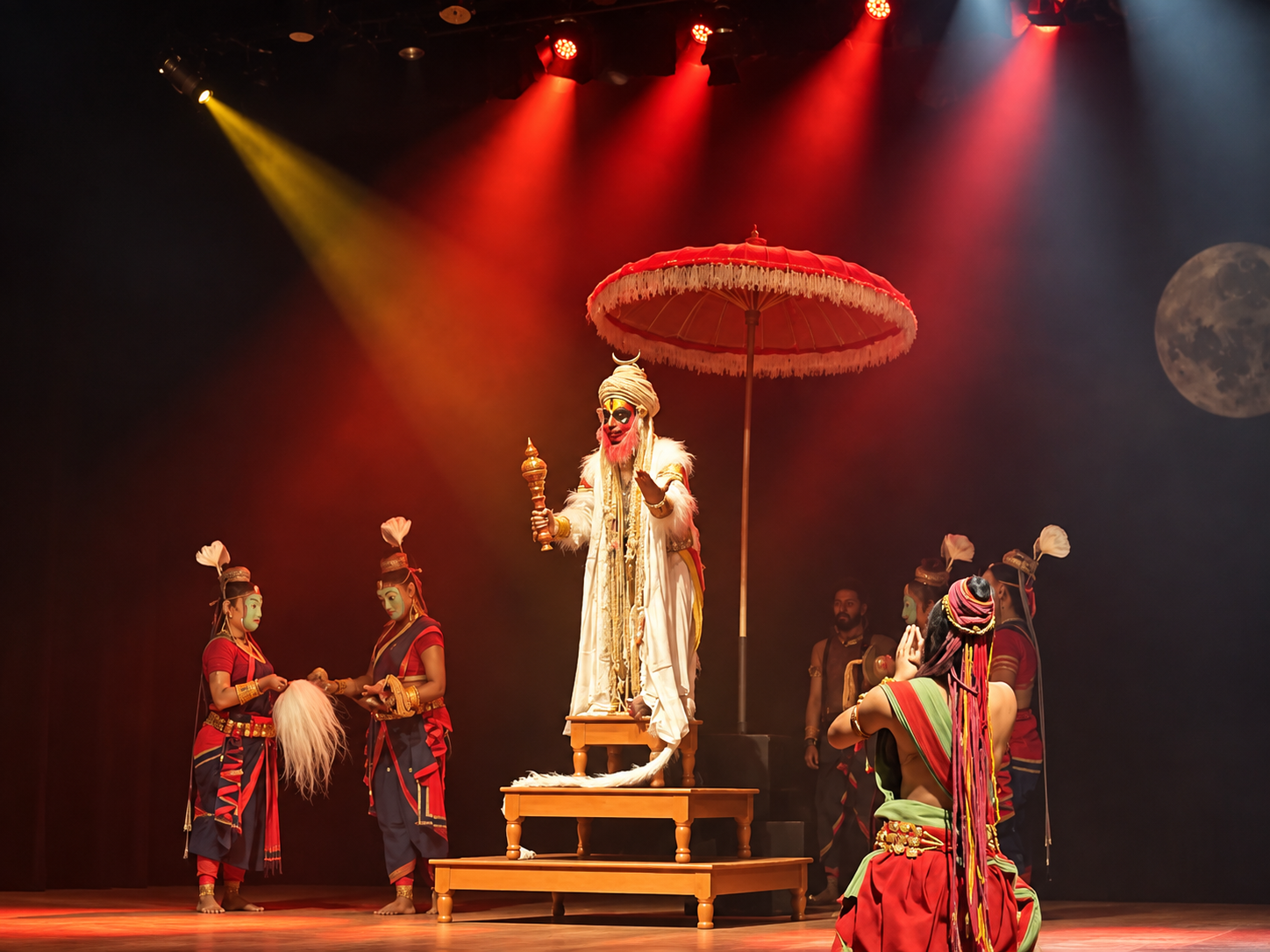
The story is familiar across India—the encounter between Bhima and his elder brother Hanuman. Draupadi’s desire for the celestial Saugandhika flowers leads Bhima into the Gandhamadana forest, where his immense strength and pride are challenged by an apparently old and helpless monkey. The familiar story gradually becomes a lesson in humility, restraint and the true meaning of strength.
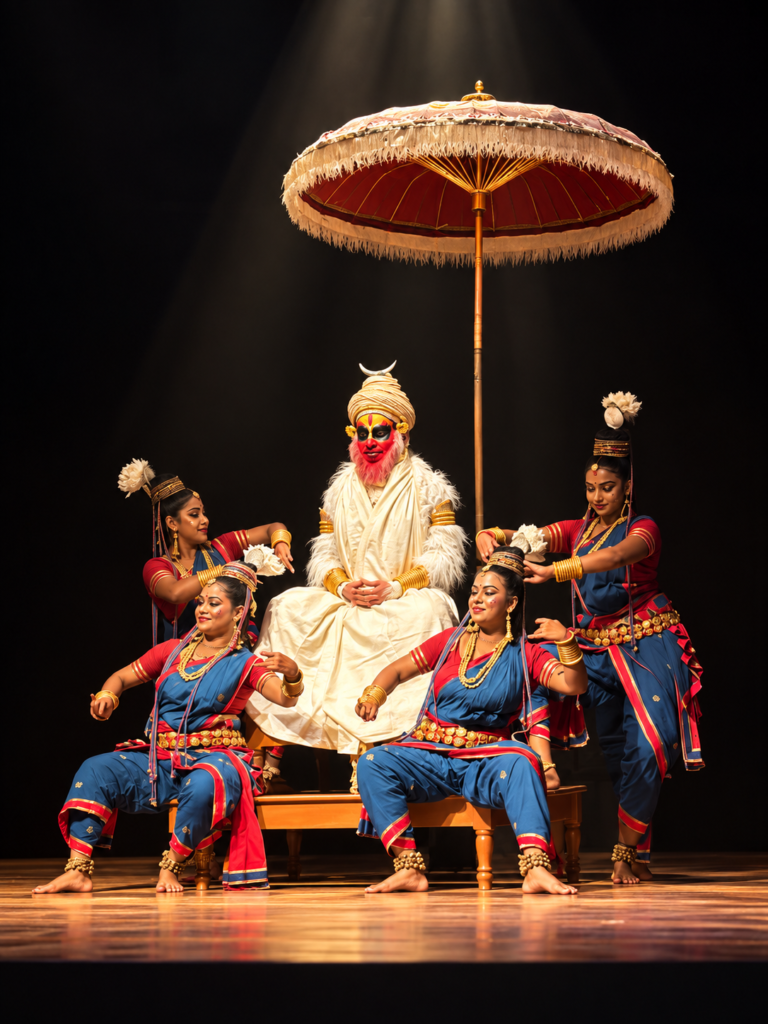
As a visual artist, I found myself experiencing the performance differently. I was constantly seeing each moment as a moving painting—a composition created through bodies, costumes, light, shadow and space. At times I completely forgot the present and felt transported into another time. For those few hours, the chaotic city outside seemed very far away.
The production is based on the 14th-century Saugandhikaharanam of Vishwanatha Kaviraja, the renowned poet and literary theorist from Odisha, with Hindi poetry by Raj Bendre. It is primarily a Sanskrit theatre presentation, with some Hindi dialogue, particularly through Hanuman, creating an interesting bridge between the classical and the contemporary.
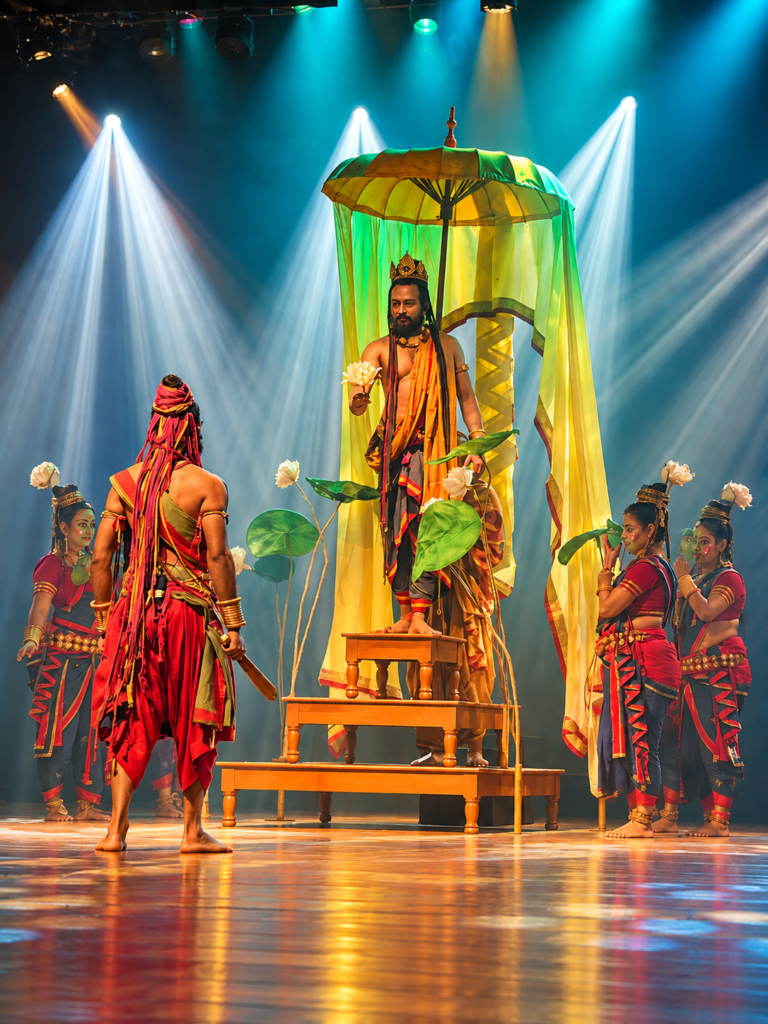
In every aspect, the production was outstanding. The costumes, masks, puppetry, traditional crafts and theatrical movement were thoughtfully composed. Purulia Chhau masks were used alongside the movement vocabulary of Baripada Chhau, creating a fascinating visual and physical synthesis. The use of solapitha to create the flowers of Kubera’s garden was another beautiful meeting of traditional craft and theatre.
Hanuman’s performance was particularly remarkable. Even while remaining seated in one place for much of the encounter, he commanded the stage through presence, stillness and controlled energy. When he finally revealed his true form, it became the highest-temperature moment of the performance—powerful, dramatic and awe-inspiring.
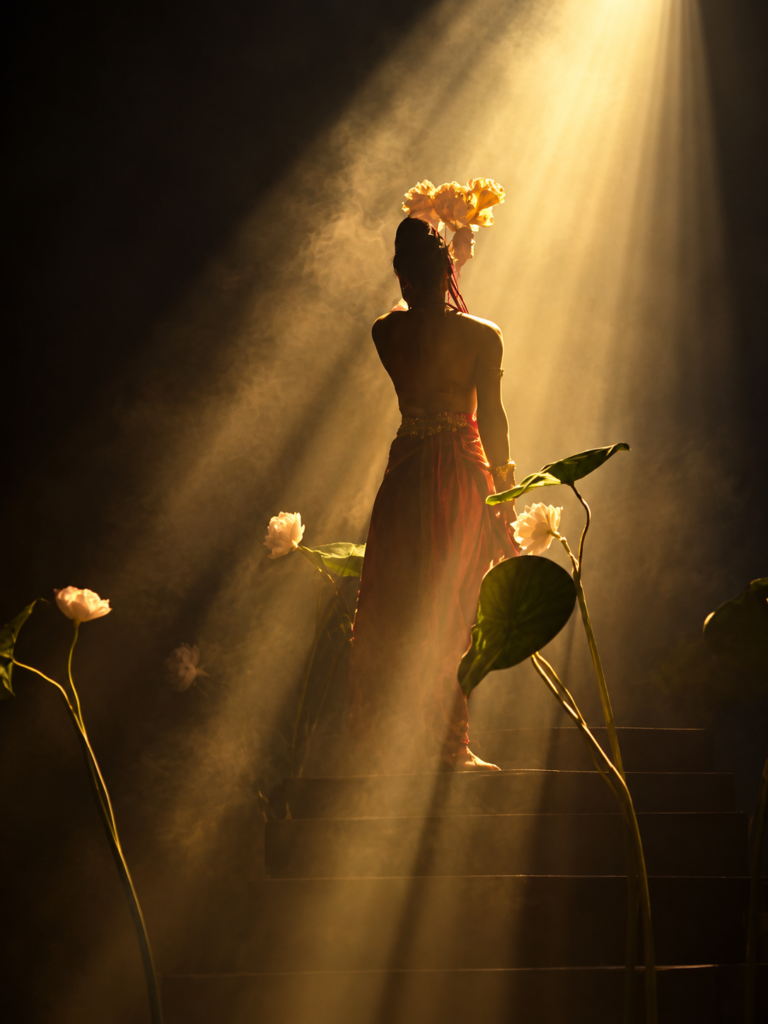
And then came one of my favourite moments: the transformation of the stage into Kuberapuri through Dinesh Poddar’s lighting design. The lighting did not simply illuminate the performance; it created an entirely different world. If Hanuman’s revelation was the most intense moment, this transformation was perhaps the coolest—a quiet visual magic.
I wanted to photograph so many of those frames, but photography was not permitted. I managed to take only a few images for this article, while a few more were kindly shared by a friend. Perhaps it was fitting. Some frames are better experienced than captured.
With live music composed by Sayak Mitra and the distinctive presence of the Kutapa orchestra tradition, the production became a seamless union of theatre, music, movement, craft and visual imagination.
I came out of the auditorium feeling that I had not merely watched a play. I had travelled somewhere—into another time, another visual world, and briefly away from the noise of everyday life. A truly magical evening.