Sarnath is one of the eight important places associated with the life of Gautama Buddha. After attaining enlightenment at Bodh Gaya, he came to Rishipattana near Varanasi. In the Mriga Vihar at Rishipattana, he met his first five disciples and delivered his first sermon. That very place is the historically renowned Sarnath.
It was a foggy winter morning in January in Banaras. Early at dawn, we set out from Varanasi towards Sarnath. Accompanying us was Professor Pradosh Mishra from the Department of Art History at Banaras Hindu University. Visiting a historical site with an art historian carries a different depth altogether. The landscape on both sides of the road appeared blurred and hazy—what little was visible was mostly hidden beneath a blanket of fog. By the time we reached Chaukhandi Stupa, the gates had not yet opened. So we went to a nearby tea stall. A few people were sitting closely together on wooden benches, sipping tea. Two elderly men stood near the coal fire, warming their hands. Along with tea, the shop offered something wonderfully delicious—bun bread sliced open, filled with thick cream (malai), and soaked with hot milk. On that cold winter morning, the taste of hot tea and that creamy milk-soaked bun felt extraordinary.

By the time we finished our tea and snacks, the gates of Chaukhandi Stupa had opened. We bought tickets and entered—we were the first tourists of the day. The Chaukhandi Stupa was built around the 4th–5th century CE. It is believed that this is the exact place where Buddha met his first disciples after arriving from Bodh Gaya. Hence, the stupa was constructed here. The octagonal structure on top of the stupa was built by Govardhan, the son of Todar Mal, in honor of the Mughal emperor Humayun. The combination of the ancient stupa and the later octagonal structure looked unusual. The fog still lingered. We walked around the stupa, took photographs, and by the time we stepped out, more tourists had begun to arrive. We continued ahead. At every ruined structure, Pradosh bhai would stop and explain. It felt as if he knew the story behind every brick of Sarnath.
Located about 8 km from Varanasi, Sarnath attracts thousands of tourists like us, along with Buddhist monks and followers from across the world throughout the year. It was here, in 528 BCE, that Buddha set in motion the Dharmachakra (Wheel of Dharma) and established the Buddhist Sangha. At that time, he was about 35 years old. The name “Sarnath” is derived from the Pali word “Sarangnath.”
It is believed that in a previous life, Buddha was born here as a Bodhisattva in the form of a deer. Once, when a king was about to hunt a doe, the Bodhisattva deer offered his own life in exchange. Moved by this compassion, the king declared the area a sanctuary for deer. Even today, a deer park exists near the Dhamek Stupa. We saw the deer through the fencing—said to be descendants of those ancient herds.
Ancient Buddhist texts mention that Buddha gave his first sermon to his five disciples at this very Deer Park. The Rishipattana of ancient times is today’s Sarnath.
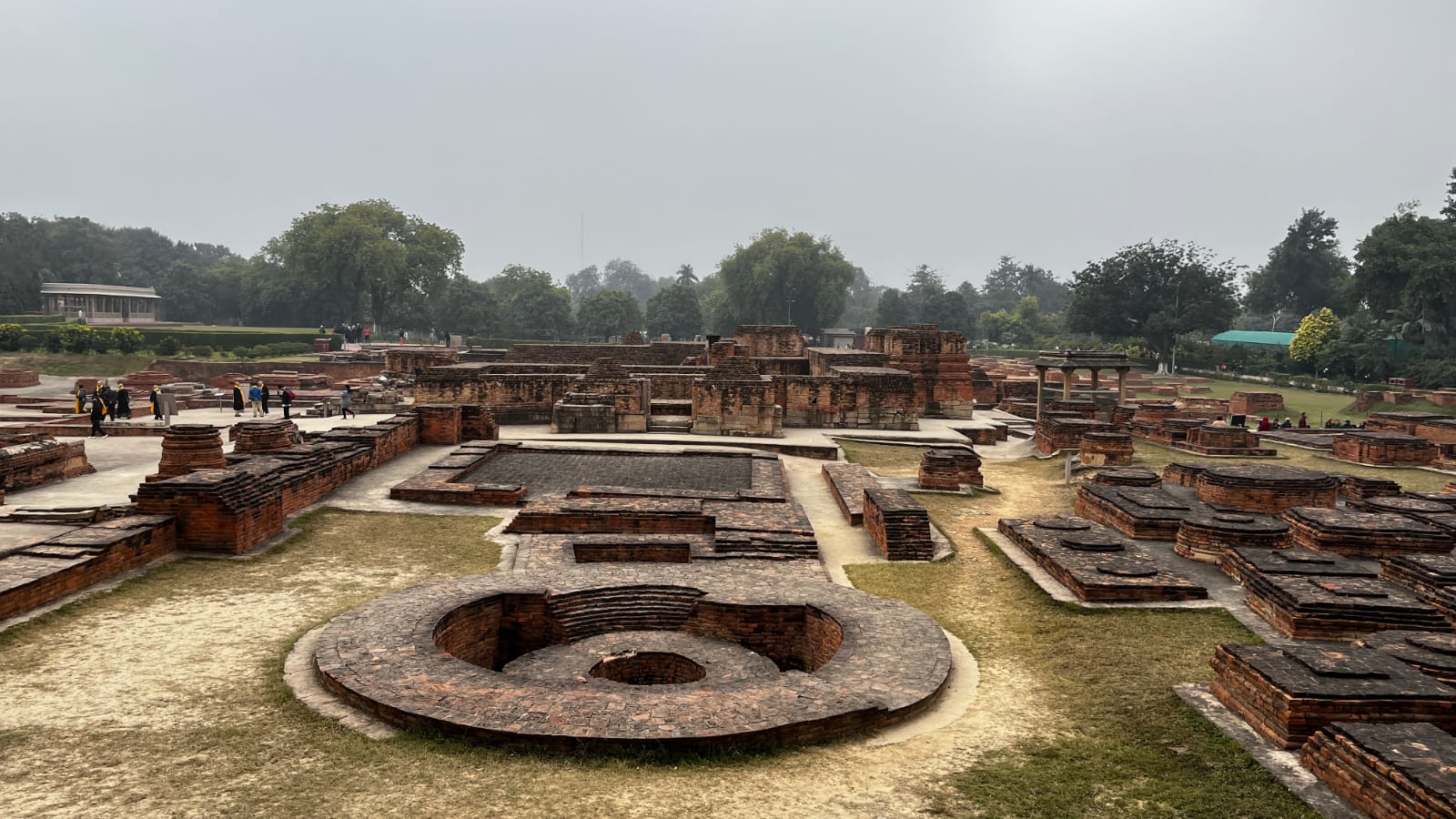
The sun remained hidden behind the fog. Broken statues of Buddha and scattered stupas lay all around. Groups of Buddhist devotees from abroad sat in rows, chanting softly in unison. An unfamiliar instrument played, its resonance creating a strange vibration within me. Tourists like us walked silently, observing the praying devotees. A sacred stillness seemed to envelop the entire place.

It felt deeply moving to imagine that centuries ago, the compassionate Shakyamuni Buddha himself walked here. Over the centuries, countless monks, teachers, and seekers must have lived and meditated here, striving for enlightenment.
Ahead stood the massive Dhamek Stupa. Small brick platforms surrounded it—places where monks once sat in meditation. The red of the burnt bricks matched the robes of the monks, spreading an aura of ascetic calm. After Buddha’s Parinirvana, his relics were distributed among eight stupas—Dhamek Stupa at Sarnath is believed to be one of them. Emperor Ashoka, after the Kalinga War, embraced Buddhism and contributed significantly to the development of Sarnath. The Ashokan pillar erected here was mentioned by the Chinese traveler Xuanzang.
The present stupa is believed to have been expanded multiple times. Built of stone and brick, it stands about 28 meters high with a diameter of over 43 meters. It features intricate Gupta-period carvings and Brahmi inscriptions. Over time, Buddhism declined in India, and Sarnath fell into neglect. In 1778, British artist William Hodges visited and sketched the site, mistakenly identifying the stupa as a Hindu temple. Later, Jagat Singh, a minister of the king of Banaras, dismantled parts of the stupa to use its bricks for constructing a market.

Excavations by British archaeologists later uncovered many sculptures and relics. In 1904–05, the Lion Capital of Ashoka was discovered here. Today, it is housed in the Sarnath Museum. Seeing the original Lion Capital—carved from a single piece of sandstone and polished to a mirror-like finish was overwhelming. The four lions stand back-to-back, with figures of a lion, elephant, bull, and horse carved below.
In 1947, on the suggestion of Prime Minister Jawaharlal Nehru, the Ashoka Chakra was adopted in the Indian national flag, and the Lion Capital became the national emblem of India. The museum also houses the famous Buddha image in the Dharmachakra Pravartana Mudra, considered one of the finest examples of Gupta art.
The sun never appeared that day. I felt disappointed that I couldn’t capture good photos or videos. Later, we visited monasteries built by different countries and even an old Jain temple nearby. By afternoon, the place became crowded. We visited the craft museum and later returned to explore the Sarnath market, buying small souvenirs for friends and family.
In the evening, the setting sun briefly appeared. Amid the bustling crowd of tourists and vendors, the calm faces of saffron-robed monks made the winter evening feel almost mystical.
As the fog thickened again, we returned to the same tea stall and enjoyed hot milk and cream-filled buns once more. The small market buzzed with evening activity. Sitting in the car as we left, I thought—centuries ago, Buddha walked these very paths, teaching the Middle Way to his disciples.
The echo of chants still lingered within me;
“Buddham Sharanam Gacchami… Sangham Sharanam Gacchami…”
I could not tell whether I felt sad… or deeply at peace.