In order to become lord or Majesty of a land, one needed to know all kind of lives in territory, specially for outsiders like colonizers, whether it’s native people or native wild animals or vegetation. So to know from humans habitat to animals habitat, from land to jungle, marine to mountains, visual documentation in newly colonized lands of South East Asia, played a great role in this agenda. In which patron’s spectatorship is very evident in all kind of painting and photography projects. Fraser Album commissioned by British Indian civil servant William Fraser is collection of company painting, which is an effort to understand and categorize different social classes and castes of India based on ethnographic gaze, where as The Impey Album is documentation of exotic birds and animals in Lady Impey’s home Menageries: A cage for wild beauty and wild beasts. The politics of presentation always comes with policy of gaze associated with the subject being depicted. Specially depiction of voiceless flora and fauna, A piece of cake for image makers, a safe side to play around, while making sensitive and impactful statement . Gaze of presenting a fauna in image is affected by the understanding and already digested perceptions about it and the animal cultures in different regions. For west, East Asia remained land of mystical animals and tribes, land of Cannibals and snake charmers. Specially presentation of political animals in images comes with certain agenda. When an animal is embelamatic for a person in power or territory, there is a great threat to animal’s own life, identity and dignity. For that matter creation of menageries and zoo for both the wild animals and wild natives, was a way to tame and rule the wild, criminalized and uncivilized indigenous. States a need for uncivilized to be caged and trained through hard labor and living condition. Also one can see Lady Impey’s Home menageries- full of wild birds and animals, as a counter practice and control of a foreign feminity over native masculinity. Oftenly these innocent voiceless living beings become a tool in political conflicts. My arguments are based on possibilities of understanding, diplomatic presentation of British lion and Bengal tiger on different historic events in image culture, produced around early and late nineteenth century in colonial India and Europe. How meaning of these imperial symbol are pole apart for two groups of people living across boarders. How the conflict between two powers is threat to animal’s own indentity and existence? How the image of voiceless becomes a site of violence and revenge in symbolic conflicts between two Powers. And how defensing the disrespect of national animal’s Image is more sensitive and diplomatic than mistreating the animal itself. For example- Tipu Sultan’s Tiger toy represents the rebellion and rage against the Britishers through the image of Bengal tiger. This tiger became symbol of native rebellion against colonizers but it doesn’t mean the own land of Bengal tiger was not mistreating it. Even before Britishers, Rajput kings and Mughal used to hunt tigers in large number. killing this beast in jungle remained a symbol of represnting masuculanitity even in early 20th century. Here the imperial image of tiger was more important than the Tiger itself. Tigers in jungle were vanishing but appearing more in crafts of the time like on painting, Sculpture, architecture, furniture, handle of swords etc. Myth says “The king of Mysore”- Tipu Sultan was named after he killed a tiger but still known as tiger lover as tigers are present on most of his craft. In Indian history another biggest feline -Lion also remained an important symbol. In folk tales and Hindu mythology. Even in precolonial India, Asiatic lion was imperial insignia of Mughals and Mauryan empire. Abul Hasan’s painting: Jahangir standing on globe and shooting poverty[1] depicts him standing on Asiatic lion who is protector of the land. These imperial art represent lion as an important symbol. In Buddhist art Buddha is also symbolized by lion many times. The Hindu War goddess Durga also mounts lion in several sculpture. In this discussion our national emblem “Lion headed Ashokan pillar”, can not be ignored. Now how come this pillar became national symbol in Independent India but not the animal of same capital as national animal. Why Bengal tiger is titled as national animal not Lion? Was relation of these two animals fixed by previous representation and image politics in colonial representation?
Animals getting associated with a land or territory are Symbolic, almost becomes substitute of each other in image cultures. Where the indexicality of presentation always gets manipulated. Where traits of the person associated with animal or bird, is understood as echo of the Pet’s own behavior. This romanticized concept also got place in Johann Caspar Lavater’s book Physiognomic Fragments [2]published around 1775, that explores the idea that a person’s inner quality can be determined by their facial features. Physical appearance as mirror of the inner quality, A good, attractive and healthy body as marker of good and healthy thought. This Eurocentric idea presented Greek classical bodies as standard and ideal body. Where as in south Asian art many Devin’s figures have zoomorphic features(like Varaha has head of wild boar where as Ganesh has head of an elephant). The Illustrations of this book resemble faces of slaves and racially backward class, ugly and wicked with animals like pig, ram or rats whereas high authority and intellectual people are resembled with lions,which means the person is having traits of the animal or bird it is associated with. Later on this idea was criticized by many scholars. Somehow the fall of animal kingdom in jungle, specially of Tigers during British rule are based on such hypothetical concept?
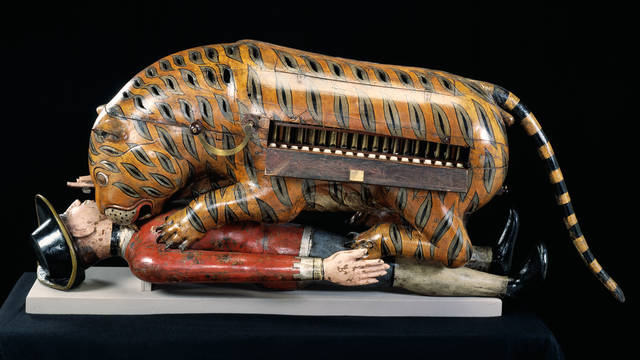
The very well known ruler of kingdom of Mysore in southern India, “Tiger of Mysore” Tipu Sultan, known for his ferocity in Battle and refusal to surrender to the British. As because of his military tactics’ and bravery he get associated With tiger, also his own fascination with the animal could be seen in his artifacts, coins, soward, flags, throne. He was so fond of tiger that his military had tiger strips on their clothes. This symbolises, his love towards tiger or his symbolic conquer over the beast of jungle ? His well known mechanical Tiger toy is one of best example of his outrage against the British Raj, where an Indian tiger is crafted, killing a European man. It’s a semi automatic wooden piece. The tiger’s mechanisms make the soldier’s left arm flail and the tiger emit growls and the soldier’s mouth emit wails. A flap on the side of the tiger folds down to reveal a small pipe organ with 18 notes. The Sculpture is beautifully crafted and painted. The color of soldier’s uniform is very specific to make it relatable. Also at the same time as the soldier’s portrait is not individualistic rather depicting a whole race of suppressors. The tiger here could be Tipu himself or the natives, awaken for freedom and rebellion. As it was personal stuff of the Sultan, his outrage and anger is very visible in the way toy is detailed with proportion, sound and kinetics.
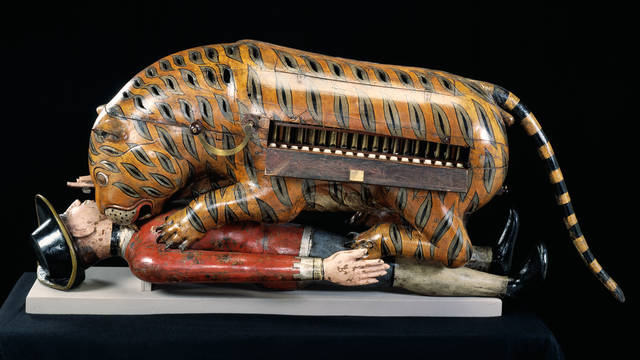
‘Image 1.Tipu’s Tiger’, 1780s or 1790s, Mysore, India. Museum no 2545 (IS). © Victoria and Albert Museum, London
This big beast in jungle of India was already a deadly threat to Britishers who wanted the land of jungle for profit of imperial expansion, needed land for agriculture, industrial development, rail routes, transportation and other needs. In both the Tiger’s territory there was great hindrance, whether it was Tiger of Mysore or Tiger of Asiatic forest. Both of them were Britisher’s target . In Forth Mysore war (1799) Tipu was killed, Threat from Mysore was removed for Britishers. But tiger in Asiatic jungle remained as a strong symbol of hinderence,rebellion and outrage for Europeans. So these voiceless animals were targeted. Here Tiger hunting symbolized construction of British imperial and foreign masculinity taking over Indian masculinity . Hunting remained: an aesthetic site of violence and revenge for centuries for Britishers. Despite the prevalence of tiger hunting as a royal sport for Mughal and Rajput but the consequences were larger during the British Raj. As Britishers wanted to present themselves as ‘New Mughals’, successor of great Mughal Empire. So inherently they copied ‘Tiger hunt’ as a imperial game to prove their masculinity, strength, courage and mastery over the land. In Mughal India at least hunting was a ceremonial phenomena but this event became chronicle in Britishers time. Enacted Forest Act of 1878 allowed them to treat jungle as a hunting ground where tiger hunting was seen as a symbol of successful conquest of nature or man’s mastery over fear . Also emerging entertainment industry of the theatre, traveling circuses and menageries, besides more Scientifically minded displays in the newly established zoo, as natural history specimen or for anatomical dissection, endangered the species. In the name of scientific study many poor animals were mistreated and killed in the process.
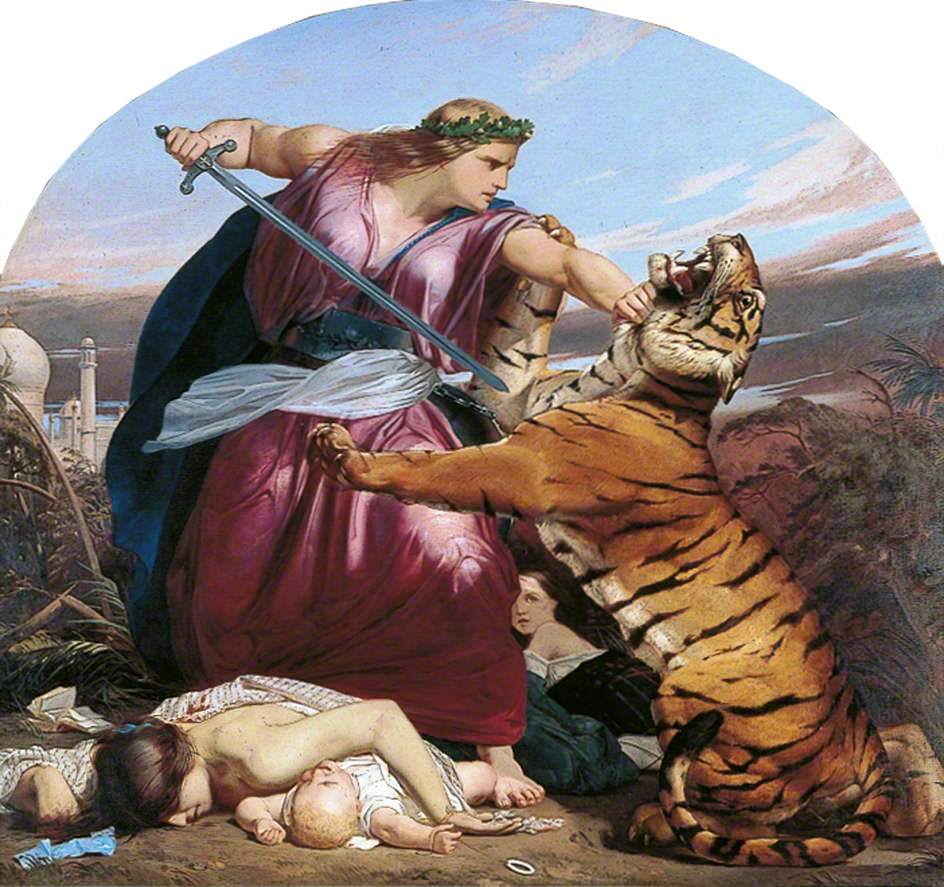
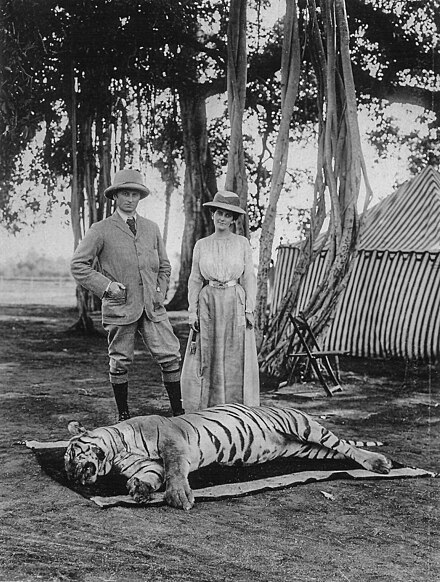
‘Retribution’ painting by orientalist painter Edward Armitage is an explicit response to the Indian Rebellion of 1857. The painting is large and square with rounded top corners, displayed in a gilded frame. It is an oil painting on canvas. In the image Britannia is depicted as rational, abled and strong masculine Female, with sword in right and holding neck of the tiger with left hand for defense. To visually support Britannia’s mortality and cruelty of Indian tiger simultaneously, a white woman and a child are painted dead near Britannia’s feet. While a third woman victim is witnessing the act of judgment from behind, at the center of composition. Here manipulated proportion of the animal and it’s action, supports it’s deed of inferiority. Also the act of Retribution is staged on the land where the imagined act of this violence took place – India. The Tajmahal on the left edge of the painting is the land marker. Also one need to understand how the idea of supreme British Feminity is created in this gendered space. In a way criticizing and challenging the Indian masculinity in it’s native land . This first attempt of freedom from colonial rule was a great shock for the East India company and to contemporary British audience. also the rebellion represented a violent uprising without justification. Here Britannia is shown vigorously killing a tiger : symbol of uncivilized and cruel Indian man who threaten and killed European woman and child in revolt of 1857 in India. Oriental presentation of Tiger under such sensitive subject, encouraged Britishers to see tiger as ruthless, cruel, demonic and it became a criminal without any crime. Whom European continued punishing to death mercilessly throughout the centuries in colonized India. Though this hunting was more an adopted activity of proving and showing one’s masculinity, from pre- colonial imperials like Mughals and Rajputs. Someone’s masculine power, strength and dignity was based on such activity. That’s how in history martial Rajputs hunting tigers in jungle are considered more masculine than Bengali Babus. In photography Image 3, Tiger hunting by George Curzon, who was a British statesman who served as Viceroy of India from 1899 to 1905. He is well remembered in Indian history for his controversial decision to part on Bengal in to two provinces. In the photography staging is clearly visible how a dead tiger is placed in front of British couples. It’s seems a camping where tent is set, the hunted tiger was brought and placed for photography. Even in this photography the way George is standing as power holder, the lady beside is empowered by his presence and Indian masculinity is laying near their feet. This clear arrangement of gender hierarchy and human superiority over animal world is created here.
While the tigers in India were widely extant and not threatened up to the first decades of the twentieth century, hunting and habitat loss reduced their population in India from 40,000 to less than 1,800 in a mere hundred years. Ofcourse this chronicle crime included proaching of animal for different medicinal and economical wealth also, but it was killed just for recreation and fun more. why specially targetting this one of biggest feline ? The question arises here even when numbers of tigers were decreasing rapidly, why still there was need to continue this hunting game ? why Europeans were influencing natives for tiger hunting with trophy and rewards ? They wanted to see native destroying their own identity, culture and history and their own land!? Even in 20th century , the tiger of jungle would remind Britishers of “Tiger of Mysore”, sustained echo of native resistance, courage and rebellion against British Raj? Even taming a live tiger in zoo, exhibiting a criminal far from native land, presenting a beast in circuses as well Disciplined, controlled and civilized pet, show imperial gaze of European eyes. As living dead: taxidermy specimen of tiger in domestic space, it’s skin as a rug near feet (which is very prominently used in paintings by Orientalist painter, John William Godward.), symbolizes a successful conquer over invincible jungle.
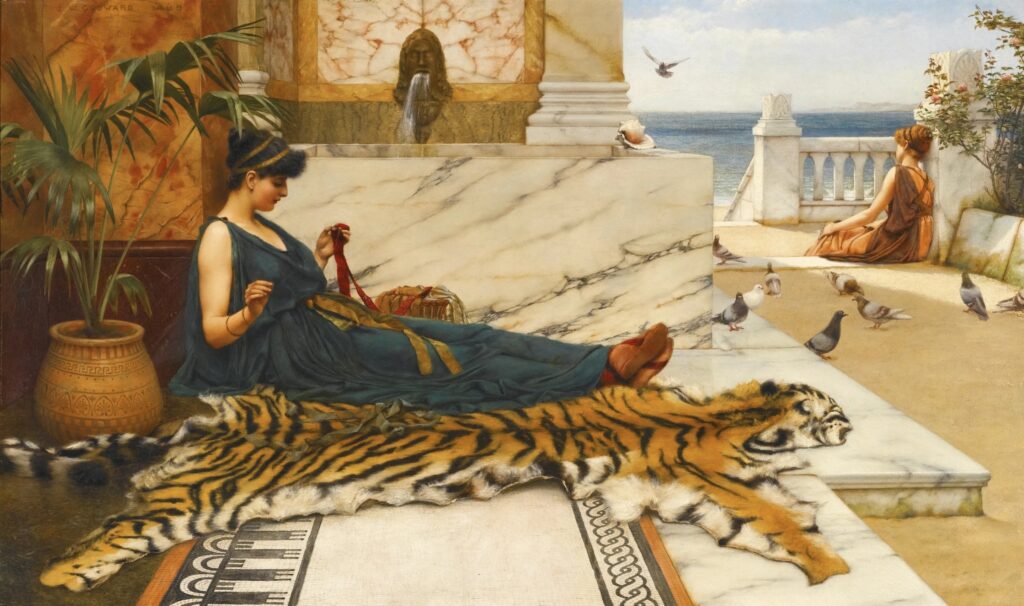
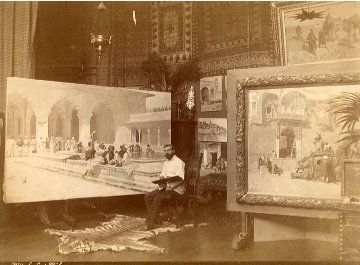
John William Godward (1861-1922) was a British orientalist painter. In his most of paintings two oriental elements are constant, classical aesthetic female body with skin of dead beasts as rug . Though he is painting subjects mostly centered around females in domestic spaces, why there is a need to exoticize the indoor feminine space with tiger skin as a repetitive element? Echoes chronological continuation of culture artist Edward Armitage painted in ‘Retribution’: Empowered and fearless female in own country where there is no threat to her security, freedom and dignity. Also this Painting counters the situation of a native female in foreign land in contrast with her presence in own civilized land. Not only in painting but presence of tiger skin in elite European’s daily life became a trend , which is visible in above photography of Edwin Lord weeks (image 5),an orientalist painter and photographer famous for picturisque painting of Lahore street and Maratha king.
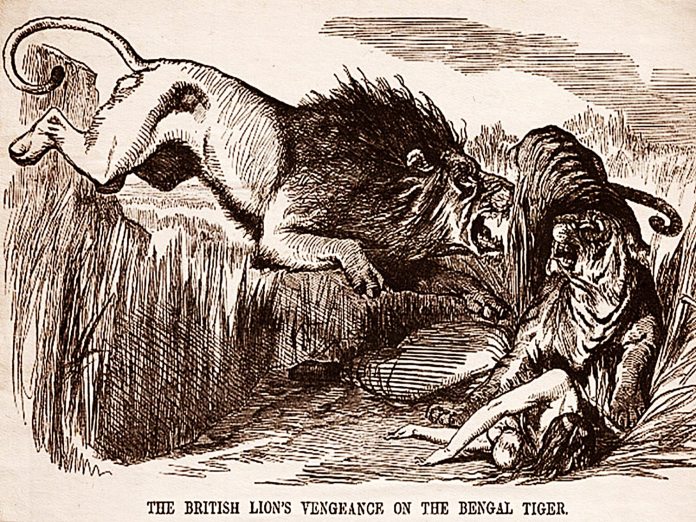
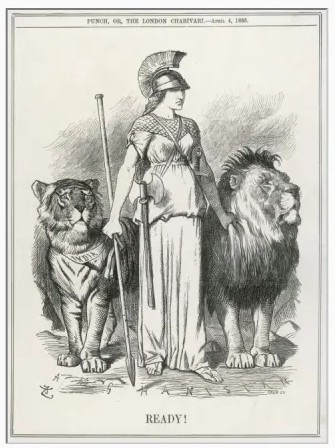
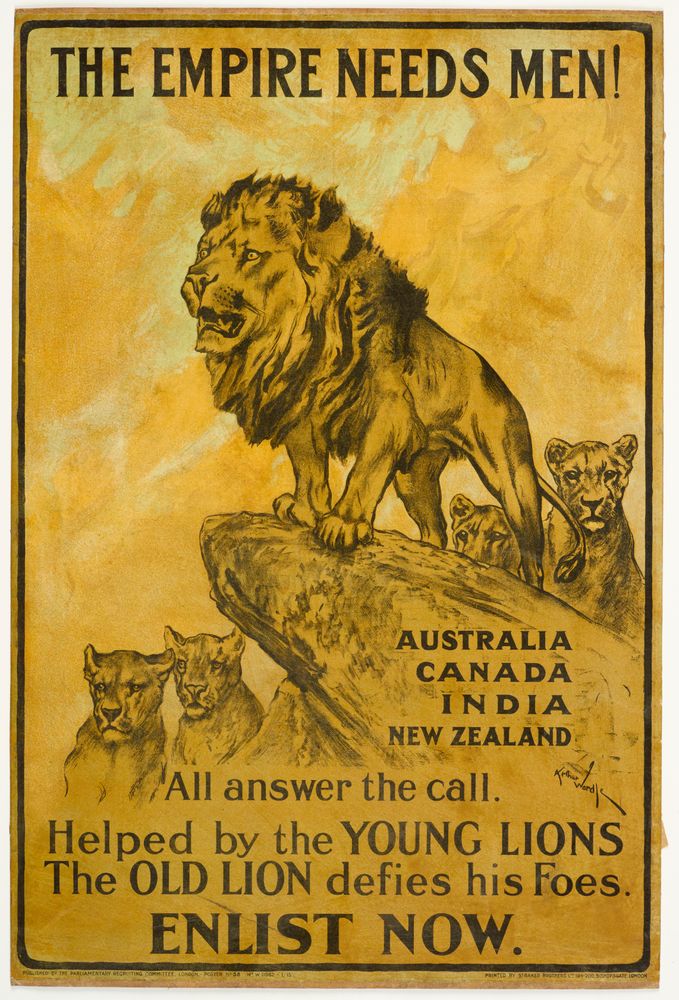
The mid-nineteenth century popular British cartoons acted as complex shortcuts that helped to powerfully influence mass opinion and consequently cultivated the public support for the Empire. “The British Lion’s Vengeance on the Bengal Tiger” is a political cartoon by John Tenniel that was first published in Punch magazine after the mutiny of 1857. It was widely circulated and expressed that passion with which British public desired revenge from Indian native just after mutiny. Here the clash between two imperial animals more support public to public revenge but ‘Retribution’ painted by Edward Armitage Later makes symbolic difference in the similar composition by making Britannia present herself. presentation of a human figure here comes with clear sense of dominance of humanastic superiority over animalistic traits. That’s what the oriental gaze in these two works presents. With the presence of Britannia is seems more judgemental in contrast with fruitless fight between two sets of public in other work. Here in Tenniel’s work, the body of non -human beasts are being used to support diplomatic relations in politics. It’s very interesting to look upon the versatile relationship between these political animals in visual culture. Just few years later, when Britain needed support of indian Soldiers in Anglo- Afghan war, a new cartoon get published in Punch magazine 1885, “Britannia and her pets, depicts Britannia accompanying both Bengal Tiger and British lion, contrasting to earlier presentations where both the majestic feline were against each other. Now they seems brothers from same majestic mother. In the drawing the Suggestive landscape of Afghan is created through small mountains at foreground and background. Also Afghanistan is written at the edges near the feet of Britannia’s Team. Britannia is ready for war with soldier and weapon. Even in this picture the confident and straight view of British lion is contrasting to the conscious and disturbed expression of Indian tiger as less experienced or Afraid fellow in war. Which need a command and training in battle field . what was political agenda behind such image ? The First Anglo-Afghan War (1838-42) was fought between the British East India Company and, the Emirate of Afghanistan, the ultimate victor. The British were keen to control Afghanistan as they feared Russian expansion into South Asia and there was need to protect settlement in British India. So Both the Bengal tiger and the British lion needed to be brought together under their master, Britannia. Both the imperial symbols are together but still different in status. One more element which is draws attention is the neck band of innocent and nervous Bengal tiger, written ‘India’ on it. Which still needed to be controlled and directed unlike British lion, does it symbolize slavery and dependency of India on Britain, still getting trained and civilized in late 19th century? Another poster from world war one used animal’s poster to encourage recruiting soldiers from colonial lands where political animals again reformed relation. The imagery and text of this British First World War poster indicate a parent-child relationship between Britain and its dominions. Australia, Canada, India and New Zealand are the ‘Young Lions’ helping Britain: The ‘Old Lion’. Here Britain is presented as well grown ‘Ruling Emperor:’ Father lion with mane. He is standing on a rock roaring and calling for faithful cubs to help him in battle .Where all four cubs depicts presence of all four Countries and cubs are waiting for the order from the master lion.
The image depicting relation of political animals are diplomatic and versatile, which greatly affects animal culture in both lands. Though both the felines Tiger and Lion are imperial symbol of two respective lands of India and Britain. It doesn’t mean the respective natives of the land’s cared for the real existence of animal. Both the animals were chronically mistreated and killed in their own land. Many zoo and circuses in the Britain were captivating lions. Similarly Tigers were being killed by natives too. But the political images produced of these Imperial animals always tried to protect it’s dignity on paper and documents. In the poster ‘Britannia and her pets’ Image didn’t present Britannia as Lion, or lion as substitute of Britannia’s image, there is always a human superiority over animals. Also creating a clear gendered space. Ofcourse lion acts as imperial symbol but just as a Savior or guard of Britain. Unlike Tiger which itself replaces ’India’ in British understanding. Representation is greatly affected by understanding of animals culture. Animal- human relatioship in the land. In European thought humanism is about overcoming animality, clearly there is a fine border between two traits. Where seeing human like emotions in animal, is not a Culture. The frontispiece of Edward Moor’s Hindu Pantheon (1810) features a rendition of Ganesh an important Hindu god :amalgamation of animal and divine body, A flat confrontation between the flat hieratic signifier of divinity and organized European visuality, was not easily digestive for European eyes[3]. How we see animals therefore testifies to our relationship with them. Different existing philosophy and understanding of animal culture existing in distant lands, affects it’s visual culture. Also affected by political gaze working behind presentation, but the real identity and existence of the animal is always on threat.
[1] Abu’l Hasan. Jahangir Standing on a Globe Shooting Poverty. ca. 1625, Los Angeles County Museum of Art
[2] Johann Caspar Lavater’s book Physiognomic Fragments
[3]The frontispiece of Edward Moor’s Hindu Pantheon (1810).
BIBLIOGRAPHY-
1.”Face him like a Briton”: Tiger hunting, Imperialism, and British masculinity in colonial India,1800-1875, Author(s): Joseph Sramek, jstorhttps://www.jstor.org
2.Catalogue, 93 PRINTEMPS | 2021 Showcasing Empire, Then and Now: Material Culture, Propaganda and the Imperial Project
3 Article: Niharika Dinkar (2021) Seeing the Elephant: Animal Spectatorship and the Imperial Gaze in Colonial India, South Asian Studies, 37:2, 117-136, DOI: 10.1080/02666030.2021.1980284, https://doi.org/10.1080/02666030.2021.1980284
4. The Columbia journal of Asia, Article by Ana Teodorescu, Tiger symbolism in the British Raj: colonialism and Animal History of the Indian subcontinent
5.Propaganda in British Raj https://medium.com/@Ankahi_Baat/propaganda-in-british-raj-8a0b5ac7e09
6. Political Animals https://farbound.net/british-lions-vengance-political-cartoon-john-tenniel-punch-1857/
7. KS3-4 Case Study – Retribution by Edward Armitage https://www.mylearning.org/stories/art-and-empire-in-leeds/1409