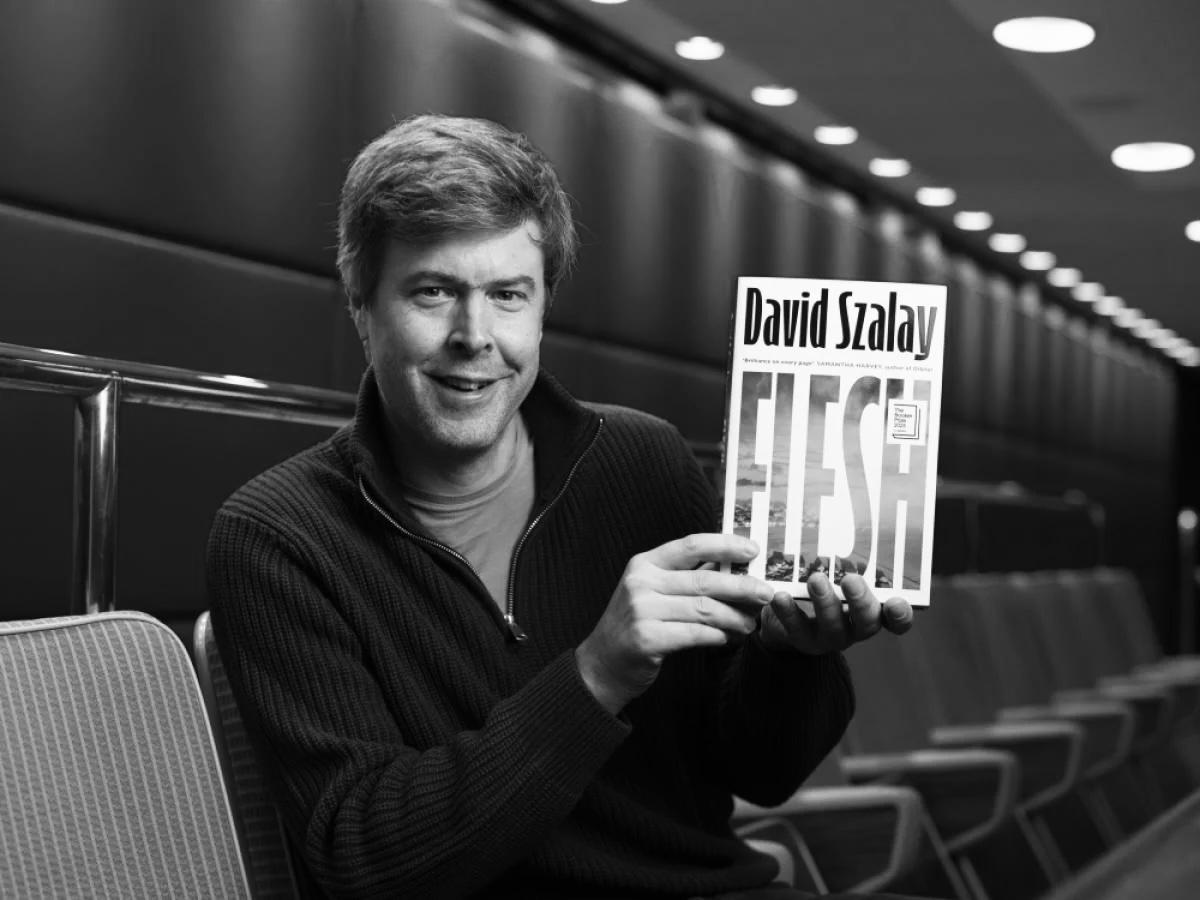
David Szalay has won the 2025 Booker Prize for his novel Flesh, and the announcement felt like one of those moments where the literary world suddenly goes quiet — as if everyone is aware that something delicate and powerful has just been recognized. The prize was declared on November 10, 2025, and for Szalay, this win comes almost ten years after his earlier book All That Man Is made it to the shortlist. This time, the award finally came home to him.
Flesh is not the kind of novel that rushes to impress you. It does not shout for your attention. Instead, it moves slowly, like a memory you don’t want to disturb. It follows István, a boy growing up in a Hungarian housing estate, and stays with him as he grows older and ends up in the elegant, polished corners of London’s upper-class world. But even as his surroundings change, something inside him remains restless, uncertain, quiet.

Szalay doesn’t tell the story in straight lines. He leaves silences, gaps, shadows. Sometimes you feel the ache of what isn’t said more than the words on the page. Roddy Doyle, the Chair of Judges, spoke about this with a kind of wonder.
“The book we kept coming back to,” he said, “was Flesh — because of its singularity. We had never read anything like it. It’s a dark book, but a joy to read. Every word matters; the spaces between the words matter.”
And truly, the spaces are where the heart of the book seems to live.
At its deepest level, Flesh is a book about the human body — the soft, unstoppable reality of living inside one. Szalay writes about how a body grows and desires, how it aches with longing, how it weakens with age, how it carries our stories even when our minds try to forget them. As István walks through different countries, different social classes, different loves and losses, he never escapes the quiet truth that he is still inside the same body. It is his home, his burden, his witness, and sometimes his only companion.
The novel breathes gently around themes of power, class, migration, and masculinity — not loudly, not dramatically, but with a kind of honesty that feels almost fragile. You feel István’s loneliness, his envy, his desire, his shame. You feel the weight of the world pressing softly against him, shaping him in ways he barely understands. Mortality, too, sits quietly in the corner of the story, reminding you that every living moment is temporary.
The Booker jury chose Flesh not because it is large or dramatic, but because it dares to be small and brave. Because it trusts silence. Because it understands that real life is made of pauses, glances, half-remembered moments, and unspoken fears. While many books insist on explaining everything, Flesh allows the reader to listen to what is not said — and somehow, that silence feels more true than any explanation could be. One reviewer said it best: it is “a novel about the living body that never forgets the mortality it carries.”

David Szalay’s own life has been shaped by movement and quiet observation. He was born in Montreal in 1974, to a Hungarian father and Canadian mother. He spent part of his childhood in Lebanon, then moved to England during the war, and later studied at Oxford. Before becoming a writer, he worked in sales and advertising — jobs that perhaps taught him how to watch people closely, to notice the small details others overlook. His earlier books — London and the South-East, The Innocent, Spring, All That Man Is, Turbulence — all carry this gentle attention to the fragile parts of people’s lives. Today he lives in Vienna, writing and teaching, and continuing to explore what it means to be human. Speaking about Flesh, he said, “I wanted to write about what it means to be a living body in the world; not the idea of life, but the experience of it.”
Maybe that is why the novel feels so intimate. It doesn’t tell you what life means. It simply sits beside you and shows you what life feels like — moment by moment, breath by breath, memory by memory. In a world full of noise, Flesh speaks softly. And somehow, that softness carries further than loudness ever could.