“Sarukalā”—a deceptively simple, plain-sounding word—carries a deep, philosophical meaning within the world of Patachitra art. Though absent from the three Odia dictionaries and lexicons I possess, it is a compound word formed from “saru” and “kalā.” Its formation is akin to mixing two distinct colors to create a new hue, or the fusion of two independent ragas into a composite melody. The exact origins of its entry into common usage remain open to research, but it is a technical term belonging to the specialized vocabulary of the traditional chitrakara households that sustain the Patachitra practice.
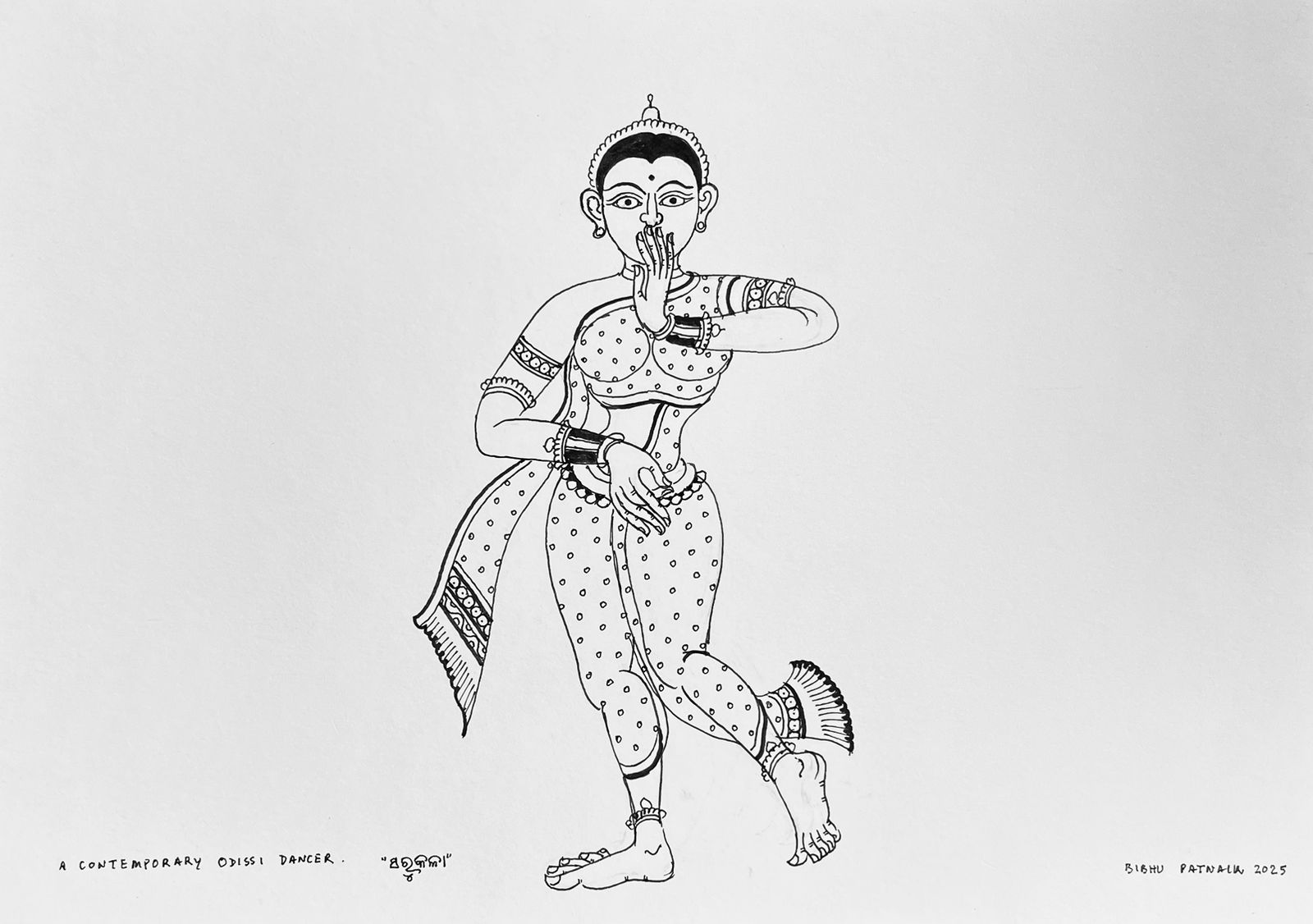
The most important and visually attractive stage in Patachitra is Sarukalā, the fine black line work. This exquisite work uses a traditional artistic black pigment prepared from lamp soot (lampblack).
From a sharp artistic subconscious—a place of restraint and discipline—the sarukalā flows from the tip of the brush. It moves in a gentle, almost wavelike motion. Even while remaining within the confines of discipline, the subtle sarukalā line progresses at a moderately calm pace, much like the unrestrained, yet graceful, path of a liberated bird.
Sarukalā is produced solely by the movement of the brush tip. The line is characterized by its consistent density and refined subtlety rather than alternating between thick and thin. To truly grasp a line’s depth demands daily discipline in sarukalā practice. A line itself is considered an elemental principle, and to penetrate that realm, one must cultivate a practiced, purposeful approach to line work. The inherent nature of sarukalā is calm and composed. When sarukalā is restless, the line forfeits its deeper, philosophical meaning. Ultimately, Sarukalā represents the locus of zero dimensionality