
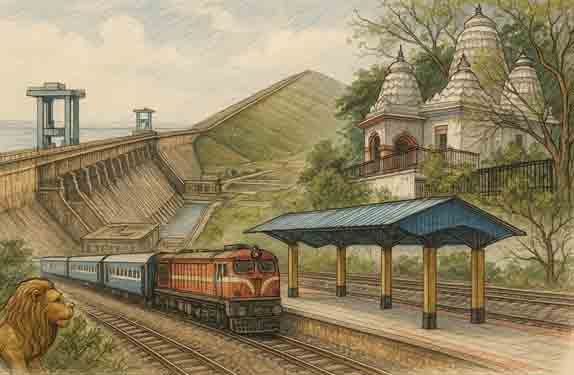
The route ahead was cloaked in a pale fog, that familiar companion of winter mornings. As the train eased its pace, the nearing halt became evident. A quick glance at the clock confirmed what we already sensed Sambalpur Junction was close to. This station, a vital hub in western Odisha, connects routes stretching toward Jharsuguda, Titlagarh, and Cuttack, quietly managing the rhythm of regional travel. From the window, we glimpsed the sleepy choreography of a railway platform just waking up: vendors setting up their carts, flasks steaming with chai, a few passengers wrapped in shawls still dozing on benches. Loudspeakers crackled to life, announcing arrivals in both English, Hindi and Odia, while porters in red uniforms wheeled past with sleepy urgency. Our train hissed to a halt. The platform smelled of wet concrete and warm chai. We, the sister duo, stepped out with our usual luggage and wide-eyed excitement. After a quick cup of hot tea from a small stall near the footbridge, we exited the station. As planned, our pre-booked taxi was already waiting at the gate, its windshield speckled with dew, the driver nodding with a smile that felt like an old friend welcoming us to another journey.
It was a chilly early January morning. This part of Odisha experiences both extremes of heat and cold, far sharper than the coastal regions, which we call home. If you ever plan to visit Odisha, the state will offer you mind-blowing, strange moments with its incredible geographical diversity. You’ll find everything here, sea, rivers, mountains, mangrove forests, tropical forests, and vast river deltas. In one area, the heat is dry and parching, as though it could tear your skin, while in another, it’s humid, sweaty, and irritating. Yet, in some parts, you’ll even witness the rare phenomenon of thin snowfall in a tropical state. You’ll come across a giant Buddha statue, only to find, just a few meters away, sacred Shiva and Shakti Pithas. And at the same time the entire state is bound by the thread of Jagannath and Vaishnavism. On one stage, you’ll witness classical Odissi dance, and in another, tribal dance forms like Ghumura and on another stage the majestic Chhau are celebrated. In the jungle, ancient rock paintings greet you, while in the plains, traditional Pattachitra art is proudly displayed. The diversity in geography, arts, culture, cultivation, dance, and food will astonish you. I still remember a conversation I had while staying in Delhi during my PGDCC program. I shared a room with a Rajasthani girl, a dentist, and one evening, as we walked through the streets of Gautam Nagar, we started discussing food. When she heard about the variety of snacks we have at home, just the ones made from rice. Her reaction was a jaw-dropping moment. She said, “So many varieties, all made from rice? I will have to visit Odisha just for the food!” That’s the magic of Odisha. The shift in landscape and food habits with every turn of the road will always amaze you. We reached our hotel, and after checking in, we opted for a quick nap. The clock showed 5:30 AM, it was still too early to begin our tour.
By the time we finished our breakfast at the hotel, our taxi had arrived right on schedule. During most of our trips, we prefer to rely on the timeframes and suggestions provided by local drivers. Once you start placing your trust in their understanding of the place, they often respond with genuine care and a strong sense of responsibility. During our ride from the railway station to the hotel, we had already discussed our itinerary with the driver, asking him when would be the ideal time to start and which destination should come first. As per his thoughtful suggestion, we now set off toward Huma, the village that cradles one of Odisha’s most curious wonders.

For us, until we visited the Huma temple, the Leaning Tower of Pisa had always been a piece of architectural astonishment. But that winter morning nearing and then standing before the Leaning Temple of Huma was simply breathtaking. The temple didn’t just lean, it seemed to pause mid-prayer, tilting gently as if caught between time and surrender. Built on a rocky outcrop on the banks of the Mahanadi, the shrine leaned southward, quietly defying logic. The aged laterite stones, once sharp-edged, had softened with centuries of wind, rain, and whispered mantras. The vimana, imperfect in geometry but perfect in spirit, rose like a question mark left unanswered by history. No one knew for certain whether it was an architectural flaw or a divine decision but no one dared to call it incomplete. There was something oddly human about its posture. Not broken, not failing, just… leaning. Like a tired soul resting its weight on faith. I stood beneath the tilted spire, watching how the horizontal lines of the base shifted off-center, how even the sub-shrines around it leaned, some eastward, others north, each holding its own story of silent survival. The stones beneath my feet were uneven, carved with footprints worn down by countless bare pilgrim heels. I watched a boy touch the wall with his small hand, tracing the cool crevices between stones as if reading a forgotten script. Nearby, an old woman closed her eyes and tilted her head, mirroring the slant of the shrine, as though aligning herself with its sacred imbalance. In the quiet, the air smelled of incense and riverwater, as the Mahanadi flowed just steps away, carrying echoes of temple bells and distant chants downstream. Sacred fishes shimmered near the ghats, unbothered by the lean of the world above. Unlike the Leaning Tower of Pisa, which draws awe for its accidental engineering flaw, Huma’s lean feels more organic, rooted in mystery, myth, and meditative silence. There are no bustling tourist queues, no camera flashes breaking the rhythm. Just the stillness of a shrine that never asked to be a wonder, and yet quietly became one. No priest announced its miracle. No signboard explained its truth. It simply stood, century after century, a 17th-century marvel built by a Chauhan king, now weathered by sun and devotion, in quiet defiance of symmetry, teaching balance through imperfection. It leaned, yes. But it did not fall. And in that, there was grace.
The edge of the Mahanadi at Huma felt like an intimate pause, its broad waters murmuring secrets stirred by centuries of devotion. From the temple’s slanted platform, you could watch the river’s gentle current sweep past, carrying the silent offerings of pilgrims. Here, near the fish-haunted ghats, the water flowed unhurried, belying the restless energy of the world beyond. These Kudo fishes, tame enough to feed from your hand, shimmered below the surface, unmoved by the temple’s tilt, drawn only by reverence and rice. My fascination with the Mahanadi and its waters is well known, to everyone around me, and certainly to those who follow my writings. With every turn, and at every ghat, the water of Mahanadi seems to change its colour, its mood. I’ve often reflected on this in other blogs, especially while writing about the Mahanadi Delta Pilgrimage and the Ramsar sites of Odisha. What stirs me most is how the river never repeats itself, it carries history, faith, and geography with equal grace, reshaping itself in silence. The riverbank at Huma is stoic, rocky islets dotted here and there, their granite spines half-submerged, appearing like silent sentinels to the shrine above. Soft reeds swayed at the shoreline, and distant calls of temple bells echoed faintly over the water. It felt sacred not by proclamation, but by stillness and gesture, the balanced dance of water, stone, and faith. We sat on the stony steps of the riverbank, quietly immersed in the music of the Mahanadi, its waters caressing the soil in a gentle, rhythmic fashion. The waves here were soft and timid; not the roaring, crashing kind one hears by the sea, but delicate and lyrical, like the faint, melodic chime of a girl’s anklet brushing against marble floors. As the sun climbed, the chill of early morning softened and the currents brightened, still carrying the scent of incense and spent rituals upstream. Then came the gentle reminder of our schedule. We rose, leaving behind the murmuring water and the lean of history, stepping into the waiting taxi at the edge of the riverbank. There on the horizon, shimmering across the Mahanadi’s wide expanse, lay our next destination: Hirakud Dam, the vast embankment born from these same waters, a man-made titan offering a different story of control and scale. As we drove away, the reservoirs of the Hirakud reflected the rising sun, inviting us onward from the soft spirituality of Huma to the grand sweep of engineering and flood-tamed plains.

From the top of Nehru Minar, the view of the Hirakud reservoir stretched endlessly, still and shimmering, like a silent sea without waves, without hurry, without restlessness. Beneath the surface, there was a weight. Not just of depth or distance, but of memory. The water here had not simply flowed, it had flooded, uprooted, and buried. Villages, homes, temples, trees, whole lives once stood where the reservoir now silently lies. And though the river had moved on, the burden of stories remained, suspended in its stillness. Looking down, it felt as though the water carried not just silt and stone, but sorrow, the unheard voices of thousands who once lived along the river’s natural path. While watching from the tower, it was hard to believe it was a river tamed. The vast expanse of water lay motionless yet profound, as if holding its breath under the sun’s golden touch. The rays of light scattered across the surface, turning it into a giant mirror broken only by the occasional ripple, a sky captured in liquid form.
As I always say, Mahanadi is quite unpredictable. Like the changing colour of her waters, her course too is full of surprises. At Hirakud, you find her quiet and still, disciplined, like a calm child under strict supervision. Drive just 30 to 32 kilometers from Sambalpur town to Chiplima, and you will see a different Mahanadi altogether. Free, playful, singing and dancing in her own rhythm. Here at Chiplima, Mahanadi falls from a height of around 24 meters, creating a waterfall of her own. It isn’t a touristy waterfall with crowds and noise. It feels like a private corner where the river decides to let herself go, gently but with purpose. The Chiplima Hydro Power Station, built by OHPC, uses this fall to generate electricity. But even with machines around, nature remains dominant here. There’s a fish farm nearby and a Livestock Breeding Centre, small but meaningful establishments that keep the area alive in their own ways. Cross the narrow footbridge over the river at Chiplima, and you reach a place where the ringing of faith is louder than any bell on this earth. A place where a goddess waits like a mother, with open arms, and ears that listen deeply. They call her Ghanteswari, the Goddess of Bells. Devotees tie small brass bells here in the hope that their wishes will be fulfilled. The temple stands close to the riverbank, with thousands of bells hanging from every possible place, walls, gates, trees, and iron rods. And just beside it, Mahanadi flows again, this time slower, as if bowing gently to the goddess. The river and the deity seem to understand each other here. One flows, the other listens. Once we finished our prayer and clicked a few pictures, we sat under a banyan tree. It was peaceful. Our minds had emptied out, the kind of stillness you rarely find. It was almost 2:30 in the afternoon. Suddenly, our stomach reminded us we were still human. Hunger returned, strong and real. The driver looked at us and said, “Better eat here. It’ll be too late to reach town, and then you’ll have to survive on packaged snacks.”

We asked the temple priest if there was any anna prasada distribution happening. He smiled and guided us to the shaded concrete platform inside the temple premises. The food served was different, simple, but full of warmth. Plain rice, a dry cabbage stir-fry, and a mildly sweet tomato curry with just a touch of ghee and cumin. It wasn’t the usual anna bhoga we’re used to in the temples of coastal Odisha. But it felt perfect for that moment. As we got up to leave, I looked back once. A small temple. A large river. An invisible peace. Ghanteswari doesn’t roar. She heals. Not by miracles, but by making you pause and just be.

By the time we left Ghanteswari temple, the sun had already softened. Its rays had begun the gentle descent toward the western horizon. Our taxi driver, who knew Sambalpur like the back of his hand, drove us straight towards Budharaja hilltop. As we crossed the roads and winding trails, an unexpected excitement bubbled within us. Our eyes kept scanning the houses, the narrow lanes, the corners, trying to locate the place where Mom had spent her childhood. We had heard so many stories about these gullies and their people from her. We knew it was nearly impossible to identify the exact house after so many years, even for her. But sometimes, the human heart chooses to follow the trail of memories over reason. And we allowed ourselves that hope. Just before reaching the summit, we asked the driver to stop. We wanted to walk the last stretch. Stepping out onto the winding black-topped road, we slowly made our way upwards. The air felt cooler here, touched with a hint of winter. It soothed us, cleared our minds. The sounds of birds and rustling leaves became sharper, as if nature had turned the volume up. The sky wore a soft yellowish hue. A few young couples sat quietly in corners, lost in their own world of murmurs and laughter. As we approached the top, the soft ring of temple bells from the Shiva shrine welcomed us. With each step, our breath grew lighter, and then there it was. The entire town of Sambalpur unfolded before us like a painting. A thin veil of smoky mist hung just above it, as if guarding old memories and newer dreams alike. From this height, the city didn’t seem rushed or noisy. It looked peaceful, floating under the soft sky, like a dream held gently in the arms of twilight.
Mahanadi hadn’t finished her magic yet. A few final tricks were still waiting to be performed. As the town prepared itself for the evening, the sun had already dipped below the western horizon, leaving behind a soft, deep red glow smeared across the sky. Streets buzzed gently, people were busy buying vegetables and groceries before heading home. Amidst this everyday rush, a lone fisherman rowed his small deshi boat across the wide, lazy stretch of the river. Mahanadi, as if in a mellow evening mood, offered no resistance. Her waters were calm, too calm to tease or challenge. The fisherman, almost disappointed, stopped rowing. He sat silently on the edge of his boat, motionless, as if waiting for the river to react, to stir, to push back. But she didn’t. The boat remained suspended, balanced delicately between air and water, like a thought paused between two emotions. From a distance, the sounds of sandhya alati floated in the air, the rhythmic bells, conch blows, and metallic clangs of jhanja echoing from Samaleswari Temple. The evening air was fragrant with burning camphor and ghee-soaked cotton wicks flickering in clay lamps. The darshan at the temple was peaceful, untouched by chaos. No pushing, no haste. No crowd trying to overpower the moment. Just calm, like the kind of calm you feel when standing before something you have always known. As I stood in front of Maa Samaleswari’s idol, I felt the same warmth I used to feel standing beside my grandmother at the small temple of Maa Mangala in Kendrapada. That tiny shrine at the end of the gully. The idols, though different, felt like sisters. Their expressions, their grace, their presence… identical. It was as if they were whispering to me, “I am the same everywhere. My affection, my mercy, my shelter, none of these change, even if the names you call me do.”

The evening was still young when we returned to our hotel. As usual, after freshening up and sipping a cup of tea, we stepped out for our evening walk. It’s a ritual we follow almost everywhere we travel. More than sightseeing, it’s these walks through the local markets and traditional bazaars that connect us deeply to a place. These evening strolls offer something beyond what tourist spots can. The markets, lit by soft lights and humming with life, carry the true essence of the land. From the variety of shops, the way people bargain and buy, the colours and shapes of vegetables, the texture of local fabrics, to the tempting aroma of street food, everything quietly speaks about the soul of the place. Even the crowd, its pace, its rhythm, its warmth, each detail becomes a page in the story that the town is trying to tell. We strolled through the market for a few kilometres, soaking in the lights, colours, and chatter. By the time we began heading back, a familiar kind of hunger struck, the evening snack hunger. You know, that craving where your mind and tongue demand not just food, but something fragrant, fresh, and full of flavour to wake up your senses. Asking around, we found our way to a small fast-food joint tucked on the first floor of a modest building, the ground floor occupied by a few other shops. We climbed a narrow staircase and entered, not into a fancy café or a plush restaurant, but into a single room, maybe 8 by 10 feet, with just three or four round wooden tables and chairs. The kitchen was on the balcony, and the entire “staff” seemed to be just the chef, a serving boy, and a cleaning hand. When we arrived, the place was quiet. We took a corner seat, and the serving boy handed us a menu. Instead of flipping through it, we smiled and told him, “Just bring us your chef’s best.” He looked puzzled, then hurried to the balcony kitchen to consult the chef. The chef, busy over a sizzling pan, briefly looked up at us, nodded, and sent over a bottle of cold water with the boy, asking for a few minutes. Soon, the boy returned, balancing two steaming plates in his hands. He placed them before us, folded his hands politely, and said, “Here is your food, ma’am.” On each plate sat a mound of creamy white pasta, still sending up clouds of tempting aroma. We hesitated. White pasta had disappointed us many times before, and we braced ourselves for another let-down. But hunger and curiosity won. We took the first bite and bam! A burst of flavours danced on our tongues. Rich, creamy, yet perfectly balanced with herbs and seasoning, it was heavenly. We devoured the entire plate in minutes, barely speaking, only smiling between mouthfuls. Later, through one of my elder sister’s journalist friends from the Sambalpur–Jharsuguda area, we learned that the chef had once worked with an international hotel chain in Goa. No wonder the taste lingered in our memory for years. Even now, just thinking of that pasta feels delicious.
The first light of dawn had barely touched the sky when our train pulled out of Sambalpur. Through the misty morning, the town slowly faded from view, yet its essence clung to us like the lingering fragrance of incense after prayer. Sambalpur had not just shown us its sights, it had opened its heart, quietly leaving imprints on ours. The warmth of its people, the calm of its river, the flavours, the colours, the gentle rhythm of life here, each had found a corner in our memories. As the train gathered speed, I realised that though we were leaving Sambalpur behind, a part of us would always remain here, breathing with the town, in the laughter of its markets and in the whisper of the Mahanadi.