When we talk about Indian cinema, there are films, there are blockbusters, and then there is Sholay—a movie that went beyond the silver screen to become a part of our collective memory. Released on August 15, 1975, Ramesh Sippy’s Sholay redefined storytelling, character-building, and action in Bollywood, making it one of the most iconic films in the history of Indian cinema. In this 2025, Sholay celebrates its golden jubilee — a remarkable 50 years since its release. Often hailed as the greatest Indian film ever made, this timeless classic continues to live in the hearts of audiences across generations. From its unforgettable characters and iconic dialogues to its larger-than-life action sequences, Sholay has not just entertained but shaped the very language of Indian cinema.
I first witnessed a Hindi film in my village during the occasion of Khudurukuni Puja. By then, traditional theatre forms like Pala, Dasakathia, and Gitinatya were slowly fading away and considered old-fashioned. A new era had begun with the arrival of video sets and VCPs. For the villagers—cut off from cities and distant cinema halls—this became an exciting form of entertainment. It was as if our small village had stepped into a new world of cultural experience, moving from tradition to modernity in its own way.Watching full-night screenings of Odia and Hindi films, with their rich colour saturation and high contrast, we felt modern and enriched. The film screening used to be an all-night affair. It would begin with an Odia film, followed by a Hindi film after midnight, by which time the older generation had usually gone back home to sleep. By early morning, as the daylight slowly brightened, the video projection appeared faded and dim against the rising sun.

After finishing my village chapter, I moved to the city for my college studies. There, I was surprised to see how easily my friends could recognize different Hindi film heroines — while to me, they all looked almost the same. Gradually, I too began to fall in love with Hindi films. I would buy second-hand film magazines and cut out the glossy faces and glamorous poses of actresses to decorate the walls of our hostel room. From a few senior film enthusiasts, I came to know that filmmaking was far more complex than it looked on screen. Behind every film stood a team — the director, producer, cinematographer, music director, playback singers, and many more who worked tirelessly to bring stories alive.
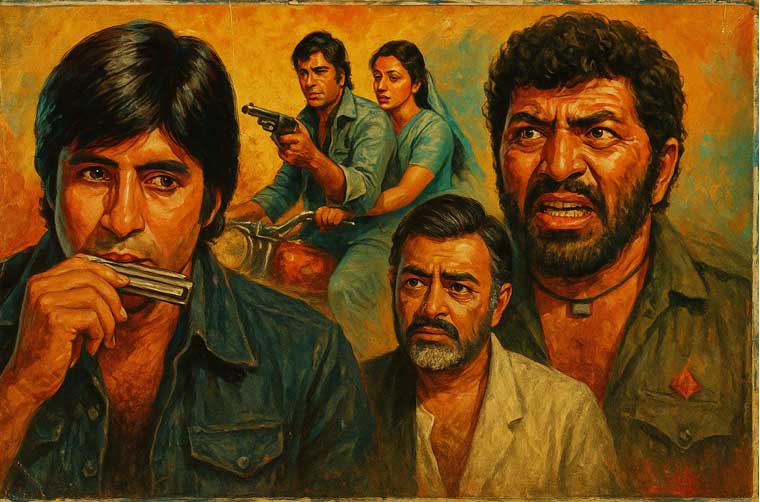
At its heart, Sholay is a story of friendship, revenge, love, and sacrifice. The plot is simple: ex-police officer Thakur Baldev Singh (Sanjeev Kumar) hires two small-time crooks, Jai (Amitabh Bachchan) and Veeru (Dharmendra), to capture the ruthless dacoit Gabbar Singh (Amjad Khan). But what makes the film extraordinary is how this simple revenge drama is layered with unforgettable emotions, dialogues, and cinematic style.It is both a Western and a very Indian story—complete with humor, tragedy, romance, and moral dilemmas.

One reason Sholay became timeless is its gallery of characters, each etched so deeply that they turned into cultural archetypes: Jai and viru, Gabbar Singh, Basanti, Thakur, Radha (Jaya Bhaduri): Quiet yet intense, her restrained performance added depth to the story.Even side characters like Soorma Bhopali, Sambha, and Rahim Chacha are remembered decades later.The dialogues of Sholay, written by Salim–Javed, are now part of Indian pop culture. Lines like “Jo darr gaya samjho marr gaya”, “Yeh haath mujhe de de Thakur”, or “Basanti, in kutton ke samne mat nachna” have crossed the boundary of cinema and entered daily conversations.
Technically, Sholay was ahead of its time. Shot in 70 mm with stereophonic sound (a first for India), the film brought Hollywood-style action and grand visuals to Indian audiences. The rocky terrain of Ramgarh (shot in Ramanagara near Bangalore) became as iconic as the characters themselves.
Ramesh Sippy’s direction, R.D. Burman’s memorable music, and Dwarka Divecha’s cinematography combined to create a film that was as much about style as it was about story. Initially, Sholay opened to lukewarm reviews, but word of mouth turned it into the biggest blockbuster India had ever seen. It ran for over five years in Mumbai’s Minerva theatre. More than a film, it became a phenomenon—setting trends for action, dialogue delivery, and the larger-than-life villain. Many film lovers point out that Sholay wasn’t created in isolation — it carries echoes of some of world cinema’s greatest works. Its core storyline draws loose inspiration from Akira Kurosawa’s 1954 masterpiece Seven Samurai, while also borrowing major plot elements from Raj Khosla’s Bollywood classic Mera Gaon Mera Desh (1971). The thrilling train robbery sequence reminds viewers of a similar moment in the British adventure film North West Frontier (1959). And the harrowing scene where Thakur’s family is massacred has often been compared to the chilling McBain family tragedy in Sergio Leone’s Once Upon a Time in the West (1968).
Sholay holds a landmark place in Indian cinema as the country’s first film to be shot in the 70 mm format with stereophonic sound. It wasn’t just a film — it was an ambitious experiment that changed the scale of Indian filmmaking forever.
The celebrated writer duo Salim–Javed were paid a signing amount of ₹10,000 for the script — an astonishing fee in the early 1970s. From the very beginning, the project carried an air of grandeur.
Casting, too, went through dramatic twists. Sanjeev Kumar was so eager to play the menacing Gabbar Singh that he even suggested altering his appearance — darkening his teeth and shaving his head — to convince director Ramesh Sippy. Eventually, however, he was given the dignified role of Thakur. Dharmendra, after reading the final draft, also expressed his desire to play Thakur, recognizing its importance alongside Gabbar. But Ramesh Sippy cleverly steered him toward Veeru’s part, joking that if he played Thakur, Sanjeev Kumar might end up winning over Hema Malini in the story — a delicate matter, since Dharmendra and Hema were already in the midst of a real-life romance, and Sanjeev Kumar had once proposed to her.

For Jai’s character, Shatrughan Sinha was considered, but it was Salim Khan who strongly recommended Amitabh Bachchan. At that time, Bachchan was still struggling to find his footing, but after a screening of Zanjeer, both the producers and Dharmendra backed his casting. It turned out to be one of the most iconic decisions in Hindi cinema.
Even Thakur’s role initially had another contender. Veteran actor Pran, who had worked with Sippy Films earlier, was discussed. Ultimately, though, Ramesh Sippy placed his faith in Sanjeev Kumar, trusting his emotional depth as a performer.
The film’s production budget, which had started at ₹1 crore, ballooned to nearly ₹3 crores — a staggering amount for the time. Despite its massive success, Sholay surprisingly won only one Filmfare Award, for Best Editing. Yet its box office performance was historic. The film enjoyed a silver jubilee run (25 weeks) in over 100 theatres across India and went on to become a cultural phenomenon — an epic that still defines Indian cinema half a century later.

I watched Sholay for the first time in 1998, twenty-four years after its release. To be honest, at first glance I didn’t like it. Later, one of my friends managed to get hold of an audio cassette of the film, and the two or three of us would spend endless afternoons listening to its dialogues. We memorized nearly every line, and in the process, we actually learned to speak Hindi through Sholay. In that sense, the film truly had a contribution in my life.
Over time, I realized why I had been disappointed initially. By the time I watched Sholay, I had already seen many other films that were heavily inspired by it. Watching them first made Sholay feel overhyped to me. But after analyzing and understanding its originality and influence, I came to appreciate why it is considered one of the greatest films in Indian cinema.
Though Sholay is filled with countless moments of laughter, tears, and excitement, even today I find myself drawn to one tender scene above all. It is the moment when Amitabh Bachchan (Jai) plays the mouth organ while Jaya Bhaduri, as Thakur’s widowed daughter-in-law, quietly moves about lighting and extinguishing the lamps. That silent exchange — a hidden love, unspoken yet deeply felt — touches the heart in a way words never could.
Today, nearly fifty years later, Sholay is not just remembered but celebrated. It is studied in film schools, quoted in political speeches, and referenced in advertisements. Few films have had this kind of cultural impact.